The University of Iceland’s Anthropology BA is a separate institution’s programme, not an INTIAU programme or partnership.
The 2026–2027 catalogue identifies a three-year, 180 ECTS route taught and examined in Icelandic, with most textbooks in English.
The language boundary is essential: an English information page or textbook does not establish English-medium instruction. The programme is worth comparing through the balance of foundations, methods, choices and independent writing. This guide concerns the full 180 ECTS route, rather than assuming the same structure for a major or minor of another size.
Read the degree requirements alongside a real course
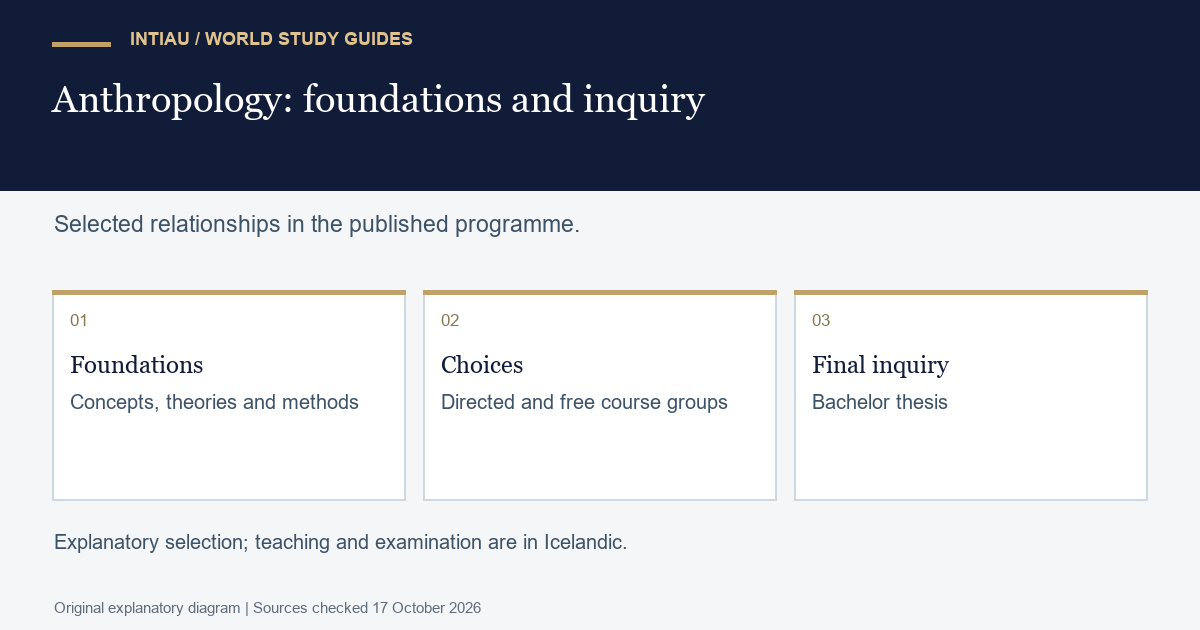
The catalogue allocates 93 ECTS to compulsory courses, 55 to restricted choices and 20 to free choices within the School of Social Sciences, followed by a 12 ECTS BA thesis. First-year study introduces social and biological anthropology, research and theory.
| Component | Published role | Question for programme comparison |
|---|---|---|
| Foundations | Core concepts and methods | How do students learn to evaluate an explanation? |
| Choices | Restricted and free course groups | Which requirements does each choice actually satisfy? |
| Final work | A 12 ECTS BA thesis | How is the question narrowed and evidence evaluated? |
The actual 2026–2027 entry for MAN103G, Inngangur að mannfræði, is a ten-credit introductory course. It covers the field’s history, theories and methods, social organisation and change. Its assessment combines a written final examination, two assignments and discussion-board participation.
Use that entry as a concrete example of learning activity, not a complete reading list for the degree. A named course may serve multiple programmes, and an entry’s availability does not mean it automatically counts in every individual’s plan. Confirm the correct year and course group before enrolling in an option.
Check qualification and language readiness
The programme catalogue requires the Icelandic matriculation examination or an equivalent foreign qualification, and describes additional recognised qualification routes.
This was checked on 17 October 2026. The cited catalogue establishes academic entry conditions, not a new 2027 application deadline. Consult the university’s current applicant information for the intended intake and recognition of your particular documents. Reading academic English and following Icelandic teaching are different abilities; investigate both before making a study decision.
Worked exercise: keep a description separate from an explanation
In an original fictional observation, twelve people enter a community hall. Eight leave their shoes by the door; four keep them on. The observer writes, “The four who kept their shoes on reject the community’s traditions.” Identify what the note supports and propose two alternative questions.
The observation supports only the recorded difference in behaviour during that visit. It does not reveal motives or even establish that there is one shared rule. Perhaps visitors received different instructions, arrived for different activities or had a practical reason for keeping their shoes on. These are possibilities to investigate, not replacement findings.
A careful description states the numbers, setting and action without assigning intention. Suitable questions include “What guidance were visitors given?” and “How do participants explain the practice in this setting?” Neither requires assuming that all participants understand or value it identically.
Your complete response should provide a revised note, separate the proposed explanations from evidence, and name one limitation of observing a single event. Score one point for accurate description, one for separating inference, one for a relevant question and one for a bounded conclusion. This is an editorial illustration, not an Icelandic course assignment or an instruction to conduct research with real participants.
Questions for prospective students
Is the degree English-taught because textbooks are often English?
No. The catalogue explicitly gives Icelandic as the teaching and examination language.
Does the introductory course use only a final examination?
No. The published entry also includes assignments and discussion participation.
Why retain alternative explanations in the exercise?
They show that one observed action can have several meanings. They remain questions until appropriate evidence supports an interpretation.
Official reading and related study
- 2026–2027 degree requirements
- MAN103G course description
- English programme information
Compare evidence-led humanities study with the Durham history guide, and practise cautious interpretation in the evidence-reading workshop. Explore further course and syllabus guides.
Related guides
View the study diagram