The University of Antwerp’s Bachelor of Social-Economic Sciences is a separate institution’s programme, not an INTIAU programme or partnership. It is an English-taught, three-year, 180 ECTS degree at Stadscampus.
This guide is for readers who want economics and social explanation in the same degree. The useful question is not whether one discipline is more important, but how the curriculum makes you connect decisions, institutions and evidence. The exercise below shows why an efficient-looking proposal can still need a distributional analysis.
Start broad, then examine the major
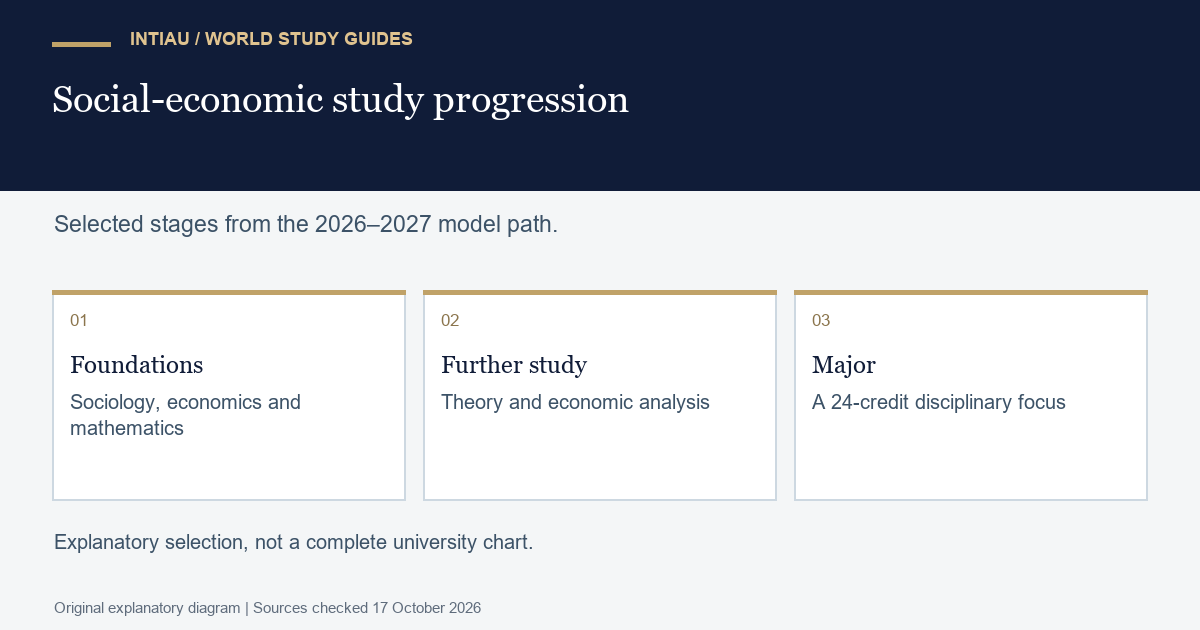
The 2026–2027 model path begins with sociology, economics, business and quantitative work. Later study allows a 24-credit major in Economics, Sociology, Business or Socio-Economics.
| Published stage | Examples | How to read the choice |
|---|---|---|
| Part 1 | Sociology; Introduction to economics; Mathematical methods | Look for foundations across several disciplines. |
| Part 2 | Sociological Theory; Microeconomics; Macroeconomics | Check how explanations become more specialised. |
| Parts 2 or 3 | A 24-credit major | Read the permitted choices before planning a pathway. |
The first-part Sociology entry has code 1009FSWSOC and six ECTS. Its published record identifies English teaching and a first-semester examination. The catalogue page also contains older academic years, so this selection uses only the 2026–2027 section.
The accessible entry did not establish a detailed weekly syllabus or examination format beyond that description. Use the linked course record to ask for the current objectives and assessment, rather than inferring them from the word “Sociology”. Similarly, do not turn a model path into permission to combine every optional course: prerequisites and the chosen major can constrain an individual plan.
Check entry requirements without importing another system
The programme requires a secondary qualification that allows entry to a comparable university programme in its country of award. Mathematics proficiency is recommended; prior economics or sociology knowledge is not required. Applicants must demonstrate English proficiency.
These are the requirements displayed when checked on 17 October 2026, not a statement that every foreign diploma is accepted. The linked institutional entry process is the place to establish your document route and intake deadline. Keep the programme’s academic prerequisites separate from document certification, immigration and practical enrolment tasks. No future deadline is inferred here from an earlier admission cycle.
Worked exercise: a policy can save money unequally
Consider a fictional city’s proposed bus-pass reform. There are 100 student pass holders. Forty travel from an outer district and sixty live centrally. The current monthly pass costs 30 units for everybody. A proposed pass costs 20 units centrally and 40 units in the outer district. Assume every person keeps the pass. Calculate revenue and identify who benefits.
Current revenue is 100 × 30 = 3,000 units. Under the proposal it is (60 × 20) + (40 × 40) = 2,800 units. Total revenue falls by 200 units. Central residents collectively save 600 units, while outer-district residents collectively pay 400 more. The average payment falls from 30 to 28 units, but the average hides opposite changes.
A satisfactory answer should therefore report both the total and the groups. “The reform reduces the average fare” is arithmetically correct under the assumptions, yet incomplete as a fairness assessment. It does not establish whether the groups have similar incomes, alternatives or service levels. It also assumes no behavioural response, so it is not a demand forecast.
Write a short recommendation with one economic and one social question. You might ask how many passes would be retained at the new prices, then ask whether the higher-cost group has realistic alternatives. Award one point each for the correct total, the two group changes, an explicit assumption and a relevant missing variable. This original exercise is not Antwerp assessment material or a recommendation for an actual transport system.
Questions about this degree map
Is the major the whole degree?
No. The major is a 24-credit component within the broader published model path, with foundations across several fields.
Must I have studied economics already?
The programme’s entry page says prior economics or sociology knowledge is not required, while mathematics proficiency is recommended.
What does the fare exercise add to programme comparison?
It tests whether you enjoy combining arithmetic with questions about distribution and assumptions, rather than treating an overall average as a complete answer.
Official reading and related guides
- Degree, language and location
- Model path and course records
- Programme entry requirements
Compare disciplinary balance with the Harvard economics guide, and examine evidence choices through the Vienna sociology guide. More course and syllabus guides are available in the existing archive.
Related guides
View the study diagram