
The BSc Computer Science and Engineering belongs to Delft University of Technology, a separate institution; it is not an INTIAU programme, branch or partnership. TU Delft describes 180 EC over 36 months and distinguishes an English track from a bilingual Dutch–English track.
Checked 17 October 2026. This guide uses the 2026/27 curriculum chart and, separately, the explicitly published 2027/28 selection procedure. Keeping those years visible prevents a current student timetable from being mistaken for the next applicant’s admissions rules.
Follow the current curriculum map
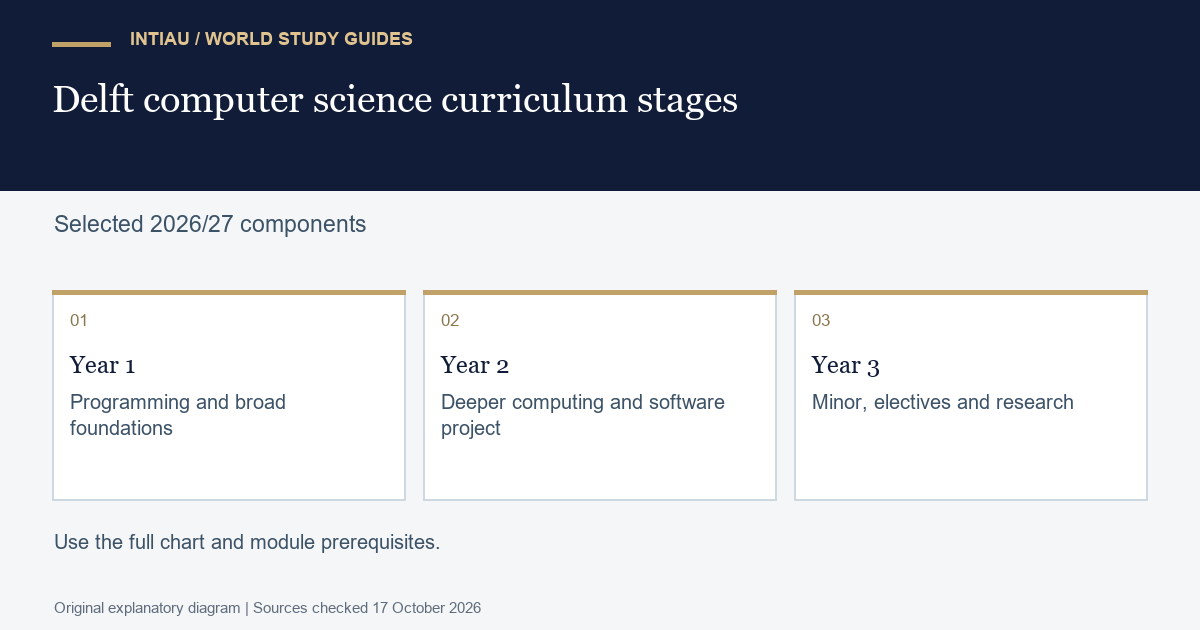
The faculty’s 2026/27 module chart supports the selected stages below. This is an abbreviated reading map; individual entry requirements and variant courses remain in the official chart.
| Stage | Examples |
|---|---|
| Year 1 | Logic, programming, hardware, mathematics, data, software design and collaborative development. |
| Year 2 | Software methods, computational theory, machine learning, graphics and a software project. |
| Year 3 | Minor, elective study and a research project. |
The map is useful because it makes several kinds of learning visible. A project can help you connect subjects, while a theoretical module can help you explain a result beyond a working example. When comparing this degree with another, avoid counting project titles alone. Ask what the project requires you to design, test, document and justify, then look for the foundations that make those tasks possible.
Use a specific syllabus as a reality check
The 2026/27 CSE11B Introduction to Programming page describes Java and object-oriented foundations. Its topics include control flow, data, classes, inheritance, library use, testing, debugging and input/output.
Try a small original practice task: build a text-based reading tracker with a book list and completion status. Begin with a clear definition of valid input. Add one feature at a time, and record tests that expose incorrect behaviour. Finally, explain which part of the design you would change if the tracker had several users. This is a way to assess your interest in careful software construction, not a sample Delft selection task.
For further syllabus research, use the faculty’s curriculum and timetable page to reach official course descriptions. Record the course code, academic year and prerequisites together. A changed course code or familiar title should prompt a version check rather than an assumption of equivalence.
Distinguish the track from selection
The programme information states that the English track is fully English-taught. Applicants with foreign diplomas normally enter that track unless they demonstrate the Dutch proficiency required for the bilingual route.
The 2027/28 selection page states that applications open in October 2026 and close on 15 January 2027 at 23:59 CET, using Studielink. Matching must be completed; selection tests mathematics and systematic reasoning/logical thinking. Ranking combines test-based lottery categories with a draw. Follow the full current brochure for operational details.
Do not turn the test topics into an invented syllabus or assume a high practice score establishes a likely ranking. Make three separate checklists: diploma admissibility, track language and selection tasks. Record completion evidence for each. Where a later action depends on an invitation or official message, keep it pending rather than guessing the next step from an older applicant’s account.
The practical choice also deserves attention. Compare your willingness to work on sustained team tasks with your interest in mathematical arguments. Describe one example of each from your own experience, including a difficulty and how you addressed it. Then compare that evidence with the learning activities you find in the official module descriptions. This produces a more informative study choice than using the word “engineering” as a proxy for either practical or theoretical content.
Prepare questions that can be answered
Before contacting the university, identify the precise gap in your information. A useful enquiry names the intended intake, qualification and relevant published requirement, then asks one question. For curriculum questions, include the module code and version. Keep unrelated personal documents out of an initial enquiry and use the institution’s stated channels for an actual application.
Frequently asked questions
Are the curriculum and admissions years the same here?
No. The curriculum chart is 2026/27; the separately published selection procedure concerns 2027/28 entry.
Does finishing matching guarantee an offer?
No. Matching completion and the selection/ranking outcome are separate steps. Read the current procedure rather than infer an offer.
Is the practice programming exercise official?
No. It is an original preparation suggestion and is not Delft teaching material or an admissions assessment.
Explore further educational reading in INTIAU Courses. Report article issues through INTIAU Contact; TU Delft decides its own admissions.
Read the TUM Informatics guide and ETH Zurich Computer Science guide for further curriculum and language comparisons. Use the curriculum-comparison workshop to record each institution’s own selection and study rules.
View the curriculum diagram
TU Delft Computer Science and Engineering: essential questions and answers
TU Delft Computer Science and Engineering is the subject of this page, presented for international readers who need a clear, official route through the material. The BSc Computer Science and Engineering belongs to Delft University of Technology, a separate institution; it is not an INTIAU programme, branch or partnership. TU Delft describes 180 EC over 36 months and distinguishes an English track from a bilingual. The guidance below explains what the page records, how the process works in 2026, and how it connects to the wider services of Azad University International. Every statement is grounded in the published content of this website, so the original page remains the authoritative source.
What This Page Covers
This page about TU Delft Computer Science and Engineering is organised so that a reader can orient quickly and then return to the original text for the controlling detail.
The page is organised around the following subjects: Follow the current curriculum map; Use a specific syllabus as a reality check; Distinguish the track from selection; Prepare questions that can be answered; Frequently asked questions.
Each section of the original page keeps its own place and wording; this summary exists so that visitors arriving from search can orient themselves before they read the full text. Where a step depends on a form, a portal or a member of staff, the route named on the original page is the route to follow.
For applicants comparing options, the practical value of this page is that it gathers the route, the responsible service and the expected preparation in one continuous explanation.
The Process in Plain Terms
This guide uses the 2026/27 curriculum chart and, separately, the explicitly published 2027/28 selection procedure.
Keeping those years visible prevents a current student timetable from being mistaken for the next applicant’s admissions rules..
The faculty’s 2026/27 module chart supports the selected stages below.
This is an abbreviated reading map; individual entry requirements and variant courses remain in the official chart..
Selected stages in the 2026/27 course offer Stage Examples Year 1 Logic, programming, hardware, mathematics, data, software design and collaborative development.
Year 2 Software methods, computational theory, machine learning, graphics and a software project.
Read the original sections in order: the early paragraphs define the scope, the middle sections describe the procedure, and the closing notes state the limits, the prerequisites and the official points of contact. Nothing on this page replaces those instructions; it only makes them easier to navigate.
Context and Background
Try a small original practice task: build a text-based reading tracker with a book list and completion status.
Begin with a clear definition of valid input.
Add one feature at a time, and record tests that expose incorrect behaviour.
Finally, explain which part of the design you would change if the tracker had several users.
This is a way to assess your interest in careful software construction, not a sample Delft selection task..
For further syllabus research, use the faculty’s curriculum and timetable page to reach official course descriptions.
Record the course code, academic year and prerequisites together.
A changed course code or familiar title should prompt a version check rather than an assumption of equivalence..
The programme information states that the English track is fully English-taught.
Applicants with foreign diplomas normally enter that track unless they demonstrate the Dutch proficiency required for the bilingual route..
The 2027/28 selection page states that applications open in October 2026 and close on 15 January 2027 at 23:59 CET, using Studielink.
Matching must be completed; selection tests mathematics and systematic reasoning/logical thinking.
Ranking combines test-based lottery categories with a draw.
Follow the full current brochure for operational details..
Do not turn the test topics into an invented syllabus or assume a high practice score establishes a likely ranking.
Make three separate checklists: diploma admissibility, track language and selection tasks.
Where a later action depends on an invitation or official message, keep it pending rather than guessing the next step from an older applicant’s account..
The practical choice also deserves attention.
Compare your willingness to work on sustained team tasks with your interest in mathematical arguments.
Describe one example of each from your own experience, including a difficulty and how you addressed it.
Then compare that evidence with the learning activities you find in the official module descriptions.
This produces a more informative study choice than using the word “engineering” as a proxy for either practical or theoretical content..
Before contacting the university, identify the precise gap in your information.
A useful enquiry names the intended intake, qualification and relevant published requirement, then asks one question.
For curriculum questions, include the module code and version.
Keep unrelated personal documents out of an initial enquiry and use the institution’s stated channels for an actual application..
Are the curriculum and admissions years the same here?
The curriculum chart is 2026/27; the separately published selection procedure concerns 2027/28 entry..
Does finishing matching guarantee an offer?
Matching completion and the selection/ranking outcome are separate steps.
Read the current procedure rather than infer an offer..
Is the practice programming exercise official?
Visitors often ask whether the summary changes the underlying procedure; it does not.
The responsible unit reviews each enquiry against the published criteria only.
Deadlines and required documents are exactly those stated on the original page.
Where translation is needed, the original English wording remains controlling.
The service does not charge for reading the public guidance on this website.
Personal data should only enter the official channels named by the University.
A complete first submission avoids most follow-up correspondence later.
The published route is the same for applicants inside and outside Iran.
Branch-specific details are confirmed through the worldwide units directory.
Course-level expectations are summarised on the education levels page.
Visitors often ask whether the summary changes the underlying procedure; it does not.
The responsible unit reviews each enquiry against the published criteria only.
Deadlines and required documents are exactly those stated on the original page.
Where translation is needed, the original English wording remains controlling.
The service does not charge for reading the public guidance on this website.
How It Connects to University Services
This topic sits inside the service family of Azad University International, the international student service of Islamic Azad University. When a step requires identity confirmation, the same record can support Azad University Verification through the official verification portal, and routine correspondence is handled through the addresses published under Azad University Email.
If the question is personal — an application, a record, a deadline — the right route is Azad University Contact: the contact page names the responsible unit and the expected form of enquiry. General orientation, such as levels, branches and study routes, is public on this website.
Practical Preparation
Before acting, prepare the reference numbers, dates and identifiers the original page asks for. Then follow the named route once, in full; repeating a submission through several channels slows the responsible unit rather than speeding it up.
Keep copies of what was submitted and note the date. Where a receipt, acknowledgement or tracking reference is offered, keep it with the prepared documents so that any later question can be answered quickly.
Official References
Two official references frame the international context of this page. The central organisation publishes institutional information at the first reference, and the encyclopaedia article at the second summarises the University's history and scale for readers who are new to it.
Related University routes: the admission process, the University contact route, the degree verification portal, the course search portal and the education levels guide.
Official references: Islamic Azad University central organisation and the University overview article.