
The Bachelor of Science in Informatics belongs to the Technical University of Munich, a separate institution; it is not an INTIAU programme, branch or partnership. TUM lists six full-time semesters, 180 ECTS and Garching as the principal location.
Checked 17 October 2026. This guide helps prospective students distinguish the current cohort’s module plan from older versions, then organise the qualification and language evidence needed for an application. Its preparation exercises are editorial suggestions, not TUM assessments or admissions promises.
Use the plan for the right cohort
The official study-plan page has a distinct section for starts from summer semester 2026. This matters because its first semester differs from the preceding cohort’s plan.
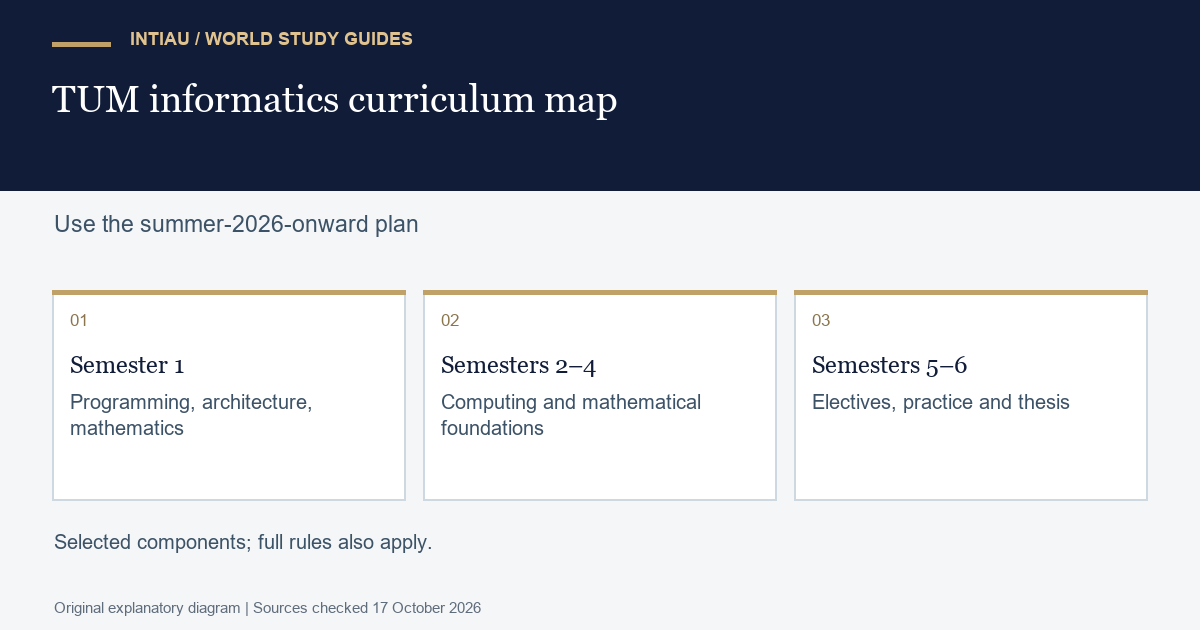
| Semester group | Curriculum examples |
|---|---|
| 1 | CIT123001 programming and informatics introduction; architecture; discrete structures. |
| 2–4 | Algorithms, software methods, databases, operating systems, security, networks and mathematical foundations. |
| 5–6 | Elective computing, numerical work, a practical component and a 12-credit bachelor thesis. |
Read the table as a map of what to investigate, not a registration checklist. A sample semester total can omit components that are distributed across several semesters. When comparing programmes, use a worksheet with separate lines for compulsory modules, electives, application subjects and broader skills. A degree that looks similar by total credits may make different demands on your mathematical reasoning or practical work.
Move from a title to a module description
The plan links directly to the CIT123001 module record. It also identifies additional application-subject and broader-foundation requirements; the short table above does not reproduce the full rules.
For each module you investigate, record the learning outcomes, assessment format, prerequisite knowledge and valid study-plan version. If a catalogue link is temporarily unavailable, leave the detail unresolved rather than borrowing it from an older course with a similar title. In particular, do not join two old module descriptions and assume that their combined content is the replacement module’s syllabus.
Try an original mini-project to test your study preferences: represent a small library catalogue, define its valid operations, and implement borrowing and returning. Write down one invariant, such as the relationship between available copies and active loans. Compare a simple list-based solution with an indexed one, then explain the trade-off. This exercise exposes the difference between writing a feature and reasoning about a system.
Language and the application route
The degree page identifies German instruction, with some courses potentially in English. Applications use TUMonline; international entrance qualifications generally need a prior uni-assist review. Its published winter application period is 15 May–15 July. The 2026 dates have passed; this is not confirmation of an open application or unchanged 2027 requirements.
The school’s admissions information describes a two-stage aptitude procedure. Documents are assessed first; the outcome can be direct admission, rejection or an invitation to a further assessment. Read the current procedure for your intake rather than self-awarding points from an older description.
Create a document index with three statuses: available, requested and clarification needed. Beside each item note who issues it and whether its wording matches the official requirement. Keep the uni-assist review and university application as separate tasks in your calendar. Completing a document review should not be treated as an admission offer.
For language readiness, practise explaining a technical solution aloud and reading a mathematical problem without immediately translating every sentence. This is a personal diagnostic, not a substitute for the university’s accepted evidence. If your current level makes the exercise difficult, budget time for both formal language preparation and technical vocabulary.
Make a comparison you can defend
Compare TUM with another programme by asking the same questions of both: What is compulsory? Which specialisation interests depend on earlier modules? What kinds of work will demonstrate learning? Which administrative steps depend on my own qualification? Record the source and cohort for every answer. A comparison built this way remains useful even if one module changes, because the unresolved decision is visible rather than hidden behind an overall ranking.
Frequently asked questions
Can I assume the programme is taught entirely in English?
No. German is the stated instructional language, although some courses may be in English.
Why not use the previous first-semester plan?
Different versions can assign different module combinations. Match the cohort heading before comparing a course code or credit total.
Does an application or document review guarantee a place?
No. Treat each process result separately and rely on the university’s actual admission decision.
Browse further educational articles in INTIAU Courses. Send article corrections through INTIAU Contact; direct TUM application questions to TUM.
Compare the ETH Zurich Computer Science guide and TU Delft Computer Science and Engineering guide without assuming that similar degree names imply matching entry rules. The curriculum-comparison workshop supplies a framework for recording the differences.
View the curriculum diagram
TUM Informatics Bachelor: essential questions and answers
TUM Informatics Bachelor is the subject of this page, presented for international readers who need a clear, official route through the material. The Bachelor of Science in Informatics belongs to the Technical University of Munich, a separate institution; it is not an INTIAU programme, branch or partnership. TUM lists six full-time semesters, 180 ECTS and Garching as the principal location.. The guidance below explains what the page records, how the process works in 2026, and how it connects to the wider services of Azad University International. Every statement is grounded in the published content of this website, so the original page remains the authoritative source.
What This Page Covers
This page about TUM Informatics Bachelor is organised so that a reader can orient quickly and then return to the original text for the controlling detail.
The page is organised around the following subjects: Use the plan for the right cohort; Move from a title to a module description; Language and the application route; Make a comparison you can defend; Frequently asked questions.
Each section of the original page keeps its own place and wording; this summary exists so that visitors arriving from search can orient themselves before they read the full text. Where a step depends on a form, a portal or a member of staff, the route named on the original page is the route to follow.
For applicants comparing options, the practical value of this page is that it gathers the route, the responsible service and the expected preparation in one continuous explanation.
The Process in Plain Terms
This guide helps prospective students distinguish the current cohort’s module plan from older versions, then organise the qualification and language evidence needed for an application.
Its preparation exercises are editorial suggestions, not TUM assessments or admissions promises..
The official study-plan page has a distinct section for starts from summer semester 2026.
This matters because its first semester differs from the preceding cohort’s plan..
Selected components of the summer-2026-onward plan Semester group Curriculum examples 1 CIT123001 programming and informatics introduction; architecture; discrete structures.
2–4 Algorithms, software methods, databases, operating systems, security, networks and mathematical foundations.
Read the original sections in order: the early paragraphs define the scope, the middle sections describe the procedure, and the closing notes state the limits, the prerequisites and the official points of contact. Nothing on this page replaces those instructions; it only makes them easier to navigate.
Context and Background
For each module you investigate, record the learning outcomes, assessment format, prerequisite knowledge and valid study-plan version.
If a catalogue link is temporarily unavailable, leave the detail unresolved rather than borrowing it from an older course with a similar title.
In particular, do not join two old module descriptions and assume that their combined content is the replacement module’s syllabus..
Try an original mini-project to test your study preferences: represent a small library catalogue, define its valid operations, and implement borrowing and returning.
Write down one invariant, such as the relationship between available copies and active loans.
Compare a simple list-based solution with an indexed one, then explain the trade-off.
This exercise exposes the difference between writing a feature and reasoning about a system..
The degree page identifies German instruction, with some courses potentially in English.
Applications use TUMonline; international entrance qualifications generally need a prior uni-assist review.
Its published winter application period is 15 May–15 July.
The 2026 dates have passed; this is not confirmation of an open application or unchanged 2027 requirements..
The school’s admissions information describes a two-stage aptitude procedure.
Documents are assessed first; the outcome can be direct admission, rejection or an invitation to a further assessment.
Read the current procedure for your intake rather than self-awarding points from an older description..
Create a document index with three statuses: available, requested and clarification needed.
Beside each item note who issues it and whether its wording matches the official requirement.
Keep the uni-assist review and university application as separate tasks in your calendar.
Completing a document review should not be treated as an admission offer..
For language readiness, practise explaining a technical solution aloud and reading a mathematical problem without immediately translating every sentence.
This is a personal diagnostic, not a substitute for the university’s accepted evidence.
If your current level makes the exercise difficult, budget time for both formal language preparation and technical vocabulary..
Compare TUM with another programme by asking the same questions of both: What is compulsory?
Which specialisation interests depend on earlier modules?
What kinds of work will demonstrate learning?
Which administrative steps depend on my own qualification?
Record the source and cohort for every answer.
A comparison built this way remains useful even if one module changes, because the unresolved decision is visible rather than hidden behind an overall ranking..
Can I assume the programme is taught entirely in English?
German is the stated instructional language, although some courses may be in English..
Why not use the previous first-semester plan?
Different versions can assign different module combinations.
Match the cohort heading before comparing a course code or credit total..
Visitors often ask whether the summary changes the underlying procedure; it does not.
The responsible unit reviews each enquiry against the published criteria only.
Deadlines and required documents are exactly those stated on the original page.
Where translation is needed, the original English wording remains controlling.
The service does not charge for reading the public guidance on this website.
Personal data should only enter the official channels named by the University.
A complete first submission avoids most follow-up correspondence later.
The published route is the same for applicants inside and outside Iran.
Branch-specific details are confirmed through the worldwide units directory.
Course-level expectations are summarised on the education levels page.
Visitors often ask whether the summary changes the underlying procedure; it does not.
The responsible unit reviews each enquiry against the published criteria only.
Deadlines and required documents are exactly those stated on the original page.
Where translation is needed, the original English wording remains controlling.
The service does not charge for reading the public guidance on this website.
How It Connects to University Services
This topic sits inside the service family of Azad University International, the international student service of Islamic Azad University. When a step requires identity confirmation, the same record can support Azad University Verification through the official verification portal, and routine correspondence is handled through the addresses published under Azad University Email.
If the question is personal — an application, a record, a deadline — the right route is Azad University Contact: the contact page names the responsible unit and the expected form of enquiry. General orientation, such as levels, branches and study routes, is public on this website.
Practical Preparation
Before acting, prepare the reference numbers, dates and identifiers the original page asks for. Then follow the named route once, in full; repeating a submission through several channels slows the responsible unit rather than speeding it up.
Keep copies of what was submitted and note the date. Where a receipt, acknowledgement or tracking reference is offered, keep it with the prepared documents so that any later question can be answered quickly.
Official References
Two official references frame the international context of this page. The central organisation publishes institutional information at the first reference, and the encyclopaedia article at the second summarises the University's history and scale for readers who are new to it.
Related University routes: the admission process, the University contact route, the degree verification portal, the course search portal and the education levels guide.
Official references: Islamic Azad University central organisation and the University overview article.