UCLouvain’s Bachelier en sciences psychologiques et de l’éducation, orientation logopédie is a separate institution’s programme, not an INTIAU programme or partnership. The 2026–2027 catalogue places this route in Louvain-la-Neuve.
Retaining the French award name avoids presenting it as an identically named qualification in another country. The practical reading task is to separate the bachelor’s foundations, the specialised study of communication and the further conditions associated with professional practice.
Understand what the three blocks contain
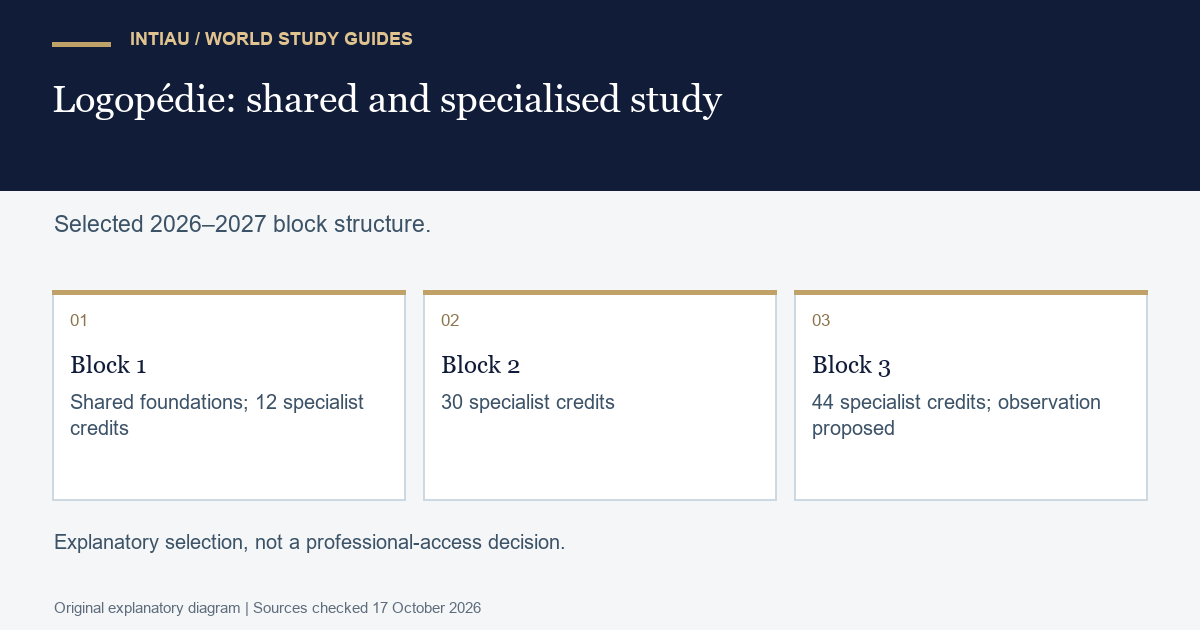
The programme totals 180 credits. Its first year combines 48 credits shared with the general psychology-and-education bachelor and 12 specific to logopédie. The following blocks contain 30 and 44 specialised credits respectively, with an observation placement proposed near the end.
| Block | Published distinction | Reading task |
|---|---|---|
| First | Shared foundations plus 12 specialised credits | Identify the foundation needed for later interpretation. |
| Second | 30 specialised credits | Follow how language and cognition become more detailed. |
| Third | 44 specialised credits; observation placement proposed | Separate observing practice from independent professional authority. |
A concrete example is LLOGO1216, Bilinguisme, a three-credit, French-taught course in the 2026–2027 catalogue. Its themes include oral and written bilingual processing, second-language acquisition and socio-affective aspects. The published assessment combines multiple-choice and open questions.
That example tells you more than a translated label such as “language studies”. It links a topic to the kinds of explanation a student must understand. It does not mean that an applicant can infer assessment rules for other courses, or use one course outline to make claims about a child’s language development.
Check access and professional boundaries separately
The catalogue’s access page includes general first-cycle qualification requirements and foreign-diploma equivalence. It also explicitly places logopédie within rules for non-resident applicants. Its 2026–2027 conditions distinguish some non-EU applicants and secondary qualifications obtained outside the EU.
Checked on 17 October 2026, those are edition-specific conditions. Establish your residence classification and diploma route with the university before planning an application; nationality alone may not answer every question. This guide supplies no invented 2027–2028 deadline or assurance of admission. Consult the separate official professional-access information for your intended jurisdiction and subsequent study.
Worked exercise: distinguish observation from interpretation
The following fictional classroom note is an editorial exercise, not a diagnostic task: “During one picture-description activity, pupil A used two languages and paused twice. Pupil B used one language and paused once. Therefore pupil A has a language problem.” List what was observed, what was inferred and what the note cannot establish.
The recorded observations concern language use and pauses in one activity. The claim of a problem is an interpretation that the note does not justify. It supplies no age, familiarity with the task, comparison across contexts or assessment by a suitably qualified professional. Counting pauses does not turn an informal note into a validated measure.
A careful rewrite is: “In this activity, A used two languages and paused twice; B used one and paused once. These observations alone do not establish the reason for the difference.” Keep the original observations rather than replacing them with a reassuring but equally unsupported conclusion that everything is necessarily fine.
For a complete answer, use three headings: observed, inferred and unknown. Put the exact activity description under observed, the proposed explanation under inferred, and the missing context under unknown. Add a sentence explaining why you would not generalise from two fictional pupils. Award one point for each correctly separated category and one for a bounded final statement.
This exercise helps you test an interest in precise communication and evidence. It does not screen, diagnose or recommend treatment. When choosing the programme, ask how teaching distinguishes research evidence, observation and supervised practice, rather than assuming a familiar English job title defines the award.
Questions for programme comparison
Is the selected bilingualism course taught in English?
No. Its 2026–2027 course record states French. The English explanation here does not change the teaching language.
Is this only specialised logopédie study?
No. The first block includes substantial shared foundations, followed by increasing specialised credit allocations.
Does the fictional note permit a diagnosis?
No. It is deliberately insufficient. The useful answer separates recorded behaviour from explanations that require appropriate assessment and context.
Official reading and related guides
- Award and catalogue edition
- Programme structure
- Bilinguisme course outline
- Access requirements and non-resident provisions
Compare the role of evidence in the Birmingham psychology guide, and practise careful interpretation through the primary-evidence workshop. Browse more course and syllabus guides.
Related guides
View the study diagram