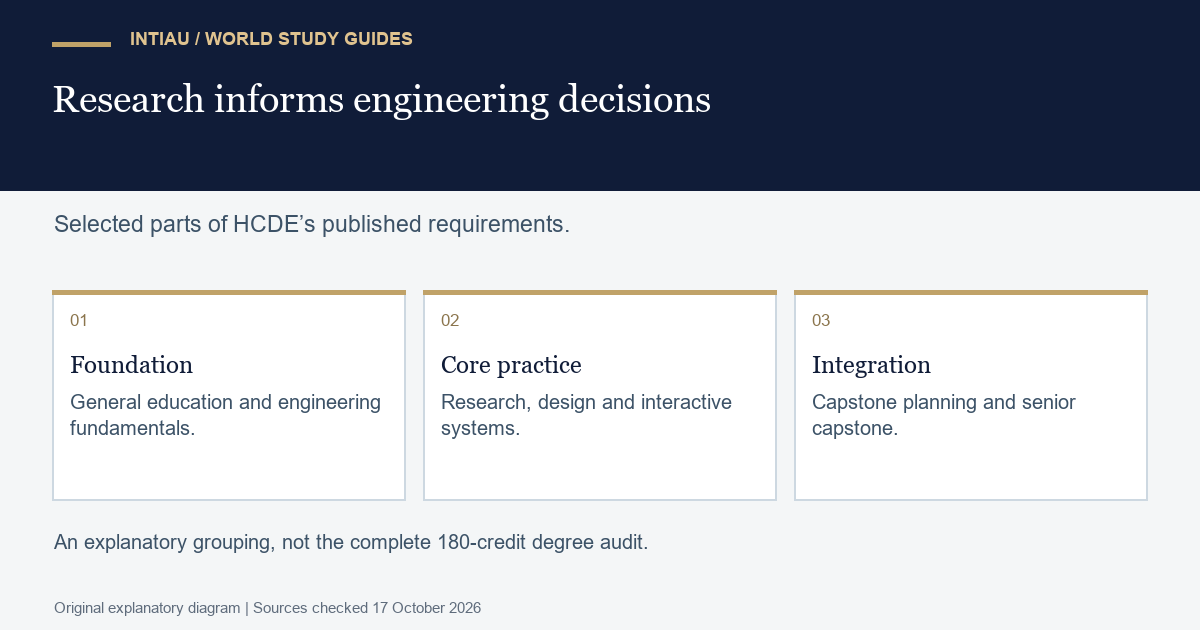
The University of Washington is a separate United States institution; its Bachelor of Science in Human Centered Design & Engineering is not an INTIAU programme. The degree requires 180 credits.
Human-centred engineering asks how a system works for people, not only whether it runs. A prospective student should look for evidence that research, design decisions and technical implementation connect. This guide distinguishes the current degree requirements from admission pathways and examines an actual user-research course.
Choose the correct entry pathway
For high-school applicants, the published route is Direct to College engineering admission: students enter Engineering Undeclared and request major placement after their first year. DTC entry is available only in autumn. Meeting placement requirements does not guarantee the first-choice major. Current UW students outside Engineering Undeclared use a capacity-constrained pathway. Transfer applicants must submit both a UW application and an HCDE application.
The admissions page also identifies a change for entry to the major in Autumn 2026 or later: precalculus, the algebra-based physics sequence and biopsychology no longer satisfy its listed prerequisites. This is a cohort-specific restriction. The page’s standing April 5 departmental date should be checked against the calendar for the intended application year.
These distinctions matter when comparing offers. University admission, engineering admission and placement into a major are not identical events. Record which of those a document actually confirms before deciding how much certainty it gives about a future study plan.
Requirements for Autumn 2024 onwards
The current requirements page applies to students admitted to HCDE from Autumn 2024. It separates general education, engineering fundamentals, experiential learning, core study and electives.
| Component | Published requirement | How to read it |
|---|---|---|
| General education | At least 85 credits. | Check the detailed subject and overlap rules. |
| Engineering fundamentals | 12 credits. | Programming is part of a broader technical foundation. |
| Experience and core | Two experiential credits and 46 core credits. | Distinguish experience from conventional taught study. |
| HCDE electives | 23 credits, with engineering and systems-and-society components. | A choice must fit the appropriate requirement. |
The 300-level core should be completed by the end of the second-to-last year to prepare for HCDE492 Capstone Planning and HCDE493 Senior Capstone. Use the complete degree rules rather than adding the table’s categories without checking overlap.
A course that links research to requirements
HCDE313 Introduction to User Research is a five-credit course. The catalogue includes interviews, surveys, usability tests, content analysis and focus groups. It addresses choosing a method, conducting research, analysing results, translating evidence into design requirements and research ethics.
HCDE310 Interactive Systems Design and Technology provides a complementary example: students specify, build and justify interactive systems in terms of user experience and technical choices. The catalogue lists introductory programming alternatives as prerequisites. These descriptions indicate what the courses cover; they do not specify an assessment weight or guarantee a particular research project. See the official course catalogue.
The useful comparison is the connection between observations and a design claim. A report of what participants said is not yet a requirement. A requirement needs a reason, a scope and some way to tell whether a proposed system satisfies it.
Try translating evidence into a design requirement
Imagine that three people miss a library renewal button. One calls it invisible, another thinks it applies to all loans, and a third expects it beside each item. Do not collapse these observations into “make the button bigger.” They describe visibility, scope and placement as different problems.
Write a requirement for each problem, then propose a small check: can a reader find the action, predict which loan it affects and confirm the result? A useful explanation preserves disagreement between observations rather than inventing one unanimous preference. This original exercise is not an HCDE assignment or a substitute for ethical research approval.
Compare the Gothenburg software programme and practise reading a university curriculum. Browse further subjects in Courses.
Questions about HCDE
Does Direct to College guarantee HCDE placement?
No. The published guidance says a student may not receive the first-choice engineering major.
Does the table apply to every historical cohort?
No. It describes the requirements labelled Autumn 2024 onwards.
Does HCDE313 cover more than interviews?
Yes. Its description includes several research methods, analysis, design requirements and ethics.
Related guides
View the curriculum diagram