The University of Portsmouth is separate from INTIAU; its BSc (Hons) Computer Networks and Security is not an INTIAU programme.
Network study is about relationships between systems: who must communicate, what should remain isolated and how a fault can be located. A prospective student can use those questions to compare a programme more meaningfully than by counting product names. This guide separates the September 2027 course page from the older linked course specification.
Entry route and document dates
The September 2027 page lists three years full time, or four with placement, and 104–120 UCAS points including two A levels and a relevant subject or equivalent.
Portsmouth explains that full-time undergraduate applicants normally use UCAS. It also permits direct applications in specified circumstances, including when Portsmouth is the applicant’s only university choice. Use the application-route guidance to choose the appropriate process.
Do not treat an annual application date or a general application guide as a course-specific guarantee. Check the live entry requirements for your qualification and confirm which course code corresponds to the standard or placement route. An optional placement year also needs its own planning; a four-year route does not identify a particular employer.
A selective map of the published modules
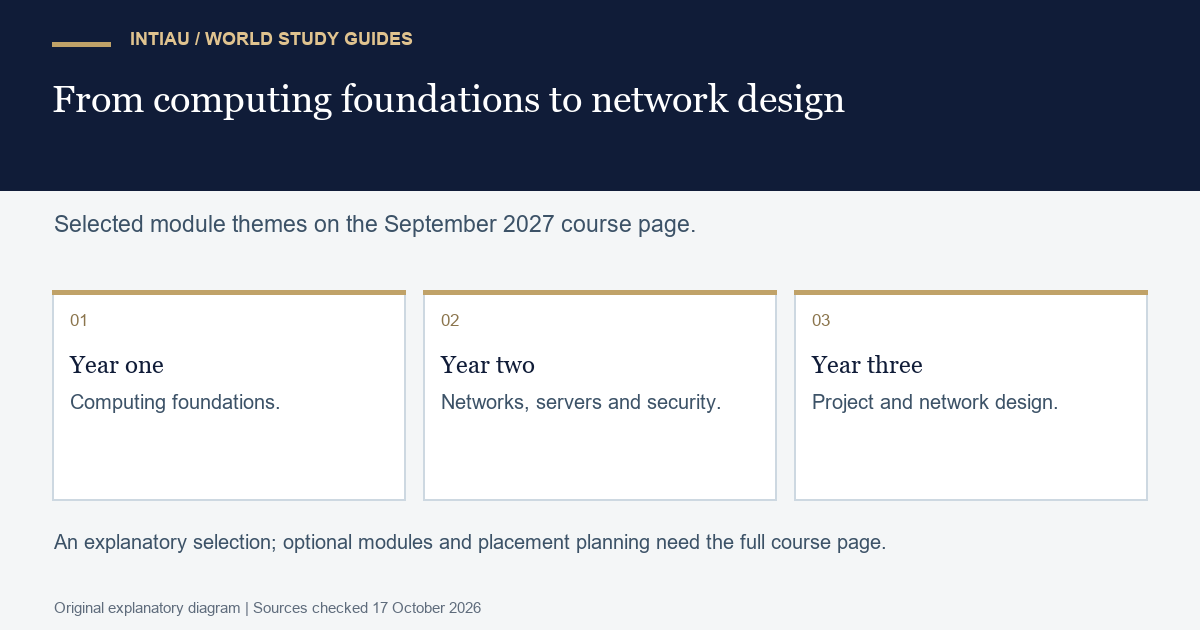
| Year | Examples on the 2027 page | Connection to investigate |
|---|---|---|
| One | Computer Systems; Programming; Data Engineering and AI. | Relate software behaviour to the systems carrying it. |
| Two | Enterprise Networking; Network Servers and Services; Security and Cryptography. | Consider connectivity, administration and protection together. |
| Three | Engineering Project; Network Design and ISP Solutions; IT and Internetworking Security. | Explain a complete design rather than one device setting. |
Network Design and ISP Solutions covers requirements, technology selection, cost and capacity planning.
Document each assumption before choosing hardware or estimating capacity.
How the specification frames learning
The linked specification applies from September 2024 and records an August 2023 version update. It describes theoretical study alongside practical design, laboratory and group work. Its outcomes include modelling network systems, systematic design and testing, and evaluating commercial, ethical and statutory considerations. It directs students to individual module descriptors for more detail.
The specification explains the broader learning framework; the current course page names newer module content. These sources should be compared, not silently combined into a claim that every line was newly approved for 2027.
A strong course comparison separates three forms of evidence. A topic list shows coverage. A learning outcome describes what a student should be able to do. An assessment description shows how that ability will be observed. None is a substitute for the other. When a public source supplies only the first two, ask for the missing assessment detail rather than inventing it.
Work through a small network requirement
Imagine a fictional workshop with staff computers, visitor Wi-Fi and a machine controller. Staff need the booking system; visitors need internet access; the controller needs only a monitoring service. Start by drawing those required connections. Do not begin by choosing a router model.
Now state a forbidden connection: a visitor device must not reach the controller. Explain where that restriction will be enforced and how a permitted monitoring connection differs. Add a failure case in which the internet link stops working. Which internal functions should continue, and how would an observer tell?
This produces a testable requirement set: permitted paths, forbidden paths and behaviour during a failure. It does not require a live security test. The exercise is original and fictional, not university coursework or permission to test anyone’s network.
For related comparisons, read the KTH ICT guide and the MIT computing pathways. Browse other subjects through Courses.
Questions about this course
Is the four-year duration the only route?
No. The page also lists a three-year full-time route.
Does the specification reproduce every module syllabus?
No. It explicitly directs readers to individual descriptors for detailed module information.
Should a network design begin with a product list?
No. First explain the required communication, restrictions and failure behaviour; products can then be assessed against those requirements.
Related guides
View the curriculum diagram