Victoria University of Wellington is a separate institution; its Bachelor of Architectural Studies with an Interior Architecture major is not an INTIAU programme or partnership. The BAS is a three-year, 360-point degree based at Te Aro, Wellington. Admission to the first year and selection into a later major are distinct decisions.
Interior study is easier to assess through the relationship between people and space than through an isolated image of a finished room. Begin with a situation: a person arrives, stores belongings, moves, waits and leaves. What information or physical arrangement helps them? Write the sequence before choosing colours or a visual style, and use it to frame your curriculum questions.
Read the stages without merging editions
| Stage | Illustrative course connections |
|---|---|
| First year | SARC111 Introduction to Design Processes; SARC112 Design Processes; shared introductory study. |
| Second year | INTA211; INTA212 or SARC216; INTA251; INTA261. |
| Third year | INTA311 or SARC313; INTA312; INTA321, alongside other requirements. |
Keep the catalogue year attached to that table. It selects examples rather than reproducing every required point or elective rule. When comparing degrees, look for the progression from introductory exploration to more integrated spatial decisions. A course code shared between two documents does not establish that its offering, assessment or place in a later curriculum remains identical.
Use a real design-processes description
The 2026 course catalogue describes SARC112 as studio-based exploration of formal and spatial composition for habitable places, including discipline-specific modules. The school’s course list identifies INTA211 as Interior Architecture Studio I and INTA312 as Interior Architecture Studio Capstone.
Read a studio description by asking what is represented, what is tested and what must be justified. A drawing may communicate a proposal without demonstrating that it meets a particular user’s needs. In a comparison sheet, distinguish descriptive course evidence from your own expectations about project work. Leave assessment weights blank unless the relevant offering actually publishes them.
Worked exercise: a shared-room conflict
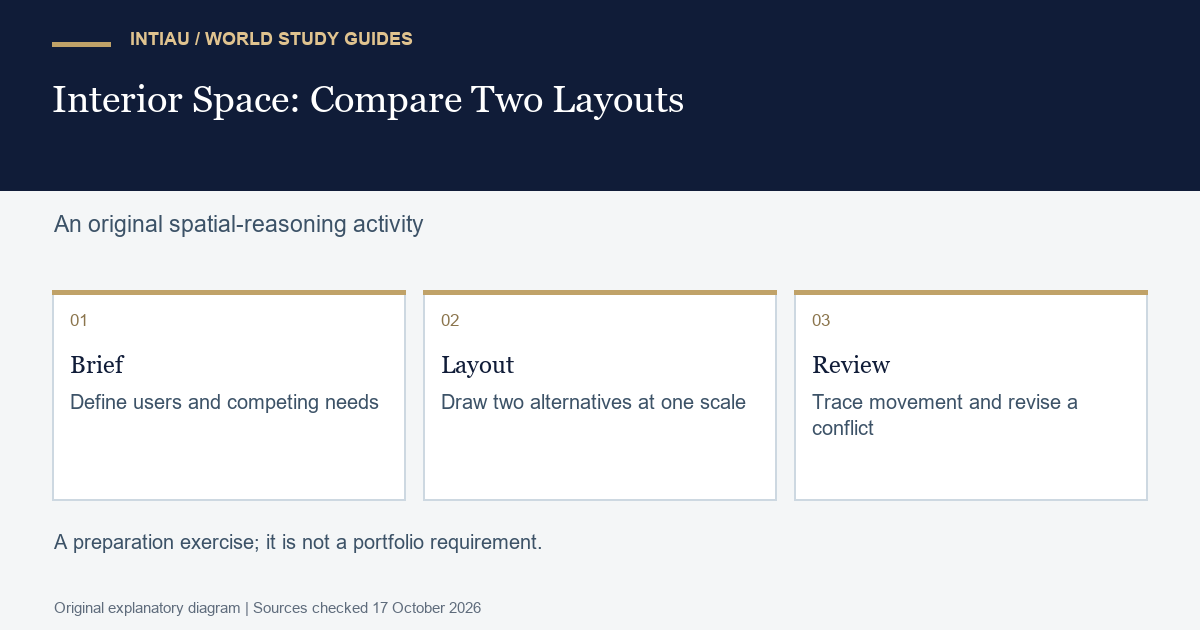
Invent a rectangular community room six units long and four units wide. The units are deliberately abstract. Give the room one entrance and two windows. Its fictional users need a quiet reading corner, a group table and a clear route to storage. Draw two layouts on identical grids. Use the same furniture footprints so a seemingly spacious option cannot win by silently shrinking the objects.
Trace three journeys on each layout: entering with a bag, reaching storage while a group is seated, and moving from a window seat to the exit. Mark intersections and points where a chair must move. Count those conflicts, but do not turn that count into a universal quality score. Some conflicts may matter more than others, depending on the brief and the user.
Change one assumption: the group now needs a display wall, or a reader needs a quieter route. Revise one layout and explain a trade-off in a short caption. Produce a brief, two scaled alternatives, a movement overlay and a revision note. Ask a peer to identify a user you overlooked. This is an original paper exercise, not an accessibility assessment, a university assignment or an admissions portfolio prescription.
Check both admission gates
The 2027 architecture handbook describes a shared first year and limited entry to second-year BAS majors, with grade-based selection where demand exceeds places. Its 1 December limited-entry deadline must not be substituted for a new student’s general application deadline.
Checked on 17 October 2026, the programme overview lists 20 January 2027 for first-trimester application and 22 February 2027 as the study start.
International applicants must meet both academic and English-language entry requirements. Check the relevant qualification route rather than applying a domestic University Entrance statement to every applicant.
Make separate checklist headings for initial university entry, later major selection and curriculum planning. Add an official source and date to each. If your intended route or application category changes, review the relevant checklist rather than carrying forward a deadline copied under different circumstances.
Three pathway questions
Does first-year entry guarantee the later major?
No. The limited-entry selection described above is a separate stage.
Is the selected table a new 2027 personal plan?
No. It illustrates the explicitly dated 2026 guide.
What makes a layout comparison useful?
Consistent dimensions, explicit users and a revision linked to an observed conflict.
Official source trail
- BAS programme overview
- 2026 undergraduate guide
- 2026 course catalogue
- 2027 architecture handbook
- International entry requirements
For INTIAU information, visit INTIAU Courses or INTIAU Contact. These links do not apply to the separate institution discussed above.
Related guides
View the study diagram