Radboud University’s Arts and Culture Studies is a separate institution’s programme, not an INTIAU programme or partnership. Its English-taught, full-time route leads to a Bachelor of Arts over three years and 180 EC.
A useful comparison asks what students actually do with cultural objects. Enjoying films or exhibitions is a starting interest; analysing a work, testing an interpretation and explaining a curatorial decision are different tasks. This guide traces that movement without treating a provisional course list as a guaranteed timetable.
Follow the published progression carefully
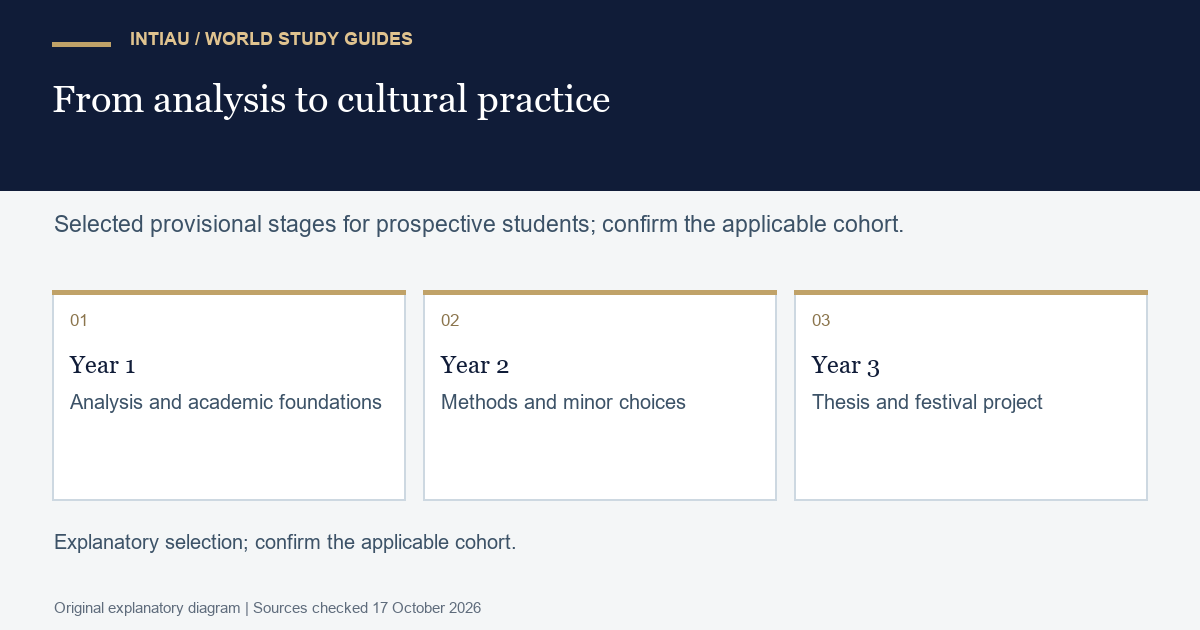
The first-year page labels its list a provisional 2027–2028 overview. It combines disciplinary introductions with analysis and academic skills; named examples include Text Analysis and Image Analysis.
The second-year page is provisionally labelled 2028–2029. It includes Research Methods in Cultural Studies, Material Culture and a 30 EC minor space.
The third-year page is provisionally labelled 2029–2030. It describes a thesis and the course Working in the Cultural Field, in which students organise a festival together.
| Stage | Selected published work | What to investigate |
|---|---|---|
| Year 1: 2027–2028 | Text Analysis; Image Analysis | How is an interpretation supported by details? |
| Year 2: 2028–2029 | Research methods and minor choices | Which method suits your question? |
| Year 3: 2029–2030 | Thesis and collaborative festival work | How do research and public presentation connect? |
The third-year page also lists an internship or study abroad among the elective possibilities.
The distinction matters when making your own plan. A possible internship is not the same thing as a compulsory one; a named course is not evidence that every student produces an identical project. Record what is required, what is optional and what still needs confirmation from the course catalogue. The current OSIRIS links did not yield readable module entries during this research, so no additional assessment weights are asserted here.
Check your own entry route
The admissions page asks for nationality and previous education. For international qualifications, it requires an individually assessed level equivalent to Dutch VWO and sufficient English. The international application involves Studielink followed by documents in OSIRIS Application. Its displayed September cycle opens on 1 October 2026; different branches show different deadlines.
Use the selector for your actual circumstances rather than copying the first date visible on the page. Save the selected route, intended intake and document checklist together. Your ability to discuss art enthusiastically does not replace formal entry requirements, and an informal eligibility indication should not be treated as an admission offer.
Worked exercise: curate an argument, not just a theme
Imagine a fictional student exhibition called Night Routes. You have three invented works: a photograph of an empty bus stop, an audio piece of overlapping journey announcements and a painted map with certain streets removed. The proposed wall text reads: “These works prove that all city travellers feel isolated.” Revise the claim and give each work a role.
A stronger wall text is: “These works invite different readings of movement, absence and access after dark.” The photograph can establish a particular visual absence; the audio can complicate that stillness with activity; the altered map can raise a question about who or what is missing. None measures how all travellers feel. That distinction separates an interpretation of selected works from an unsupported claim about a population.
Next arrange the works in two orders. In order A, place photograph, audio, map: the visitor moves from a single scene to layered activity and then a question about selection. In order B, place map first: the visitor begins by noticing that every representation leaves something out. Both orders are defensible if your explanation refers to the actual features rather than simply declaring one more emotional.
For a complete answer, submit the revised wall text, one chosen order and a 60-word explanation identifying two observable features. Use a four-point rubric: a bounded claim, evidence from the works, a reasoned sequence and recognition of an alternative reading. The exercise is original and fictional, not a Radboud assignment or a model of its marking scheme.
Questions for prospective students
Are all three year lists a single current timetable?
No. The pages explicitly present successive provisional academic years. They should not be relabelled as one final 2027–2028 timetable.
Is there a practical project?
The third-year description identifies festival organisation in Working in the Cultural Field. Confirm details for your cohort.
How can I test my interest before applying?
Try the fictional curation exercise and ask whether you enjoy defending an interpretation through evidence and revising it when another reading is plausible.
Official reading and related study
- Award and programme facts
- Provisional first year
- Provisional second year
- Provisional third year and festival course
- Applicant-specific admission routes
Compare the Sheffield literature guide for another approach to interpreting works, then practise separating evidence and commentary in the evidence-reading workshop. Find more course and syllabus guides.
Related guides
View the study diagram