
The Australian National University’s Bachelor of Engineering (Honours) is an ANU programme, not an INTIAU programme or partnership. This guide explains its systems-focused curriculum and how to approach admission and course planning. It uses the official 2027 programme listing and related university information checked on 17 October 2026.
Identify the exact degree
The 2027 AENGI listing names the Bachelor of Engineering (Honours), a four-year full-time undergraduate award requiring 192 units. ANU separately lists a Research and Development honours degree and an honours degree in Software Engineering. Check the exact programme title when comparing an application, offer or course plan.
The School of Engineering overview describes a systems approach connecting technical disciplines with design and professional practice. Rather than treating each technical subject as isolated knowledge, examine how a component behaves within a larger system and how design choices affect other requirements.
Read the curriculum as four connected building blocks
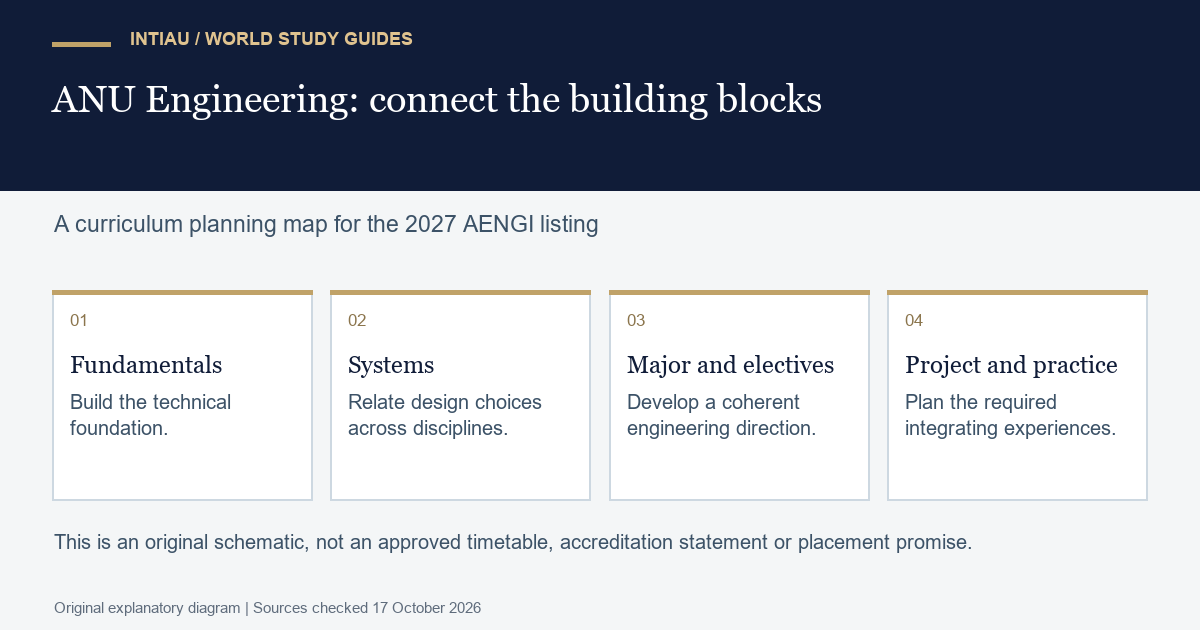
ANU’s School of Engineering groups study into fundamentals, systems engineering, an engineering major and university electives. This original table turns those building blocks into questions for course planning; it is not a copied semester-by-semester plan.
| Building block | Published content | Question to explore |
|---|---|---|
| Fundamentals | Mathematics, physics, computing, electronics and mechanics. | How does each foundation support later design work? |
| Systems engineering | Design and analysis developed through the degree. | How will I justify a choice across competing requirements? |
| Engineering major | Discipline-specific depth within the wider programme. | Which technical problems interest me enough for sustained study? |
| Electives | Permitted university study for breadth or further depth. | Which choices complement my engineering direction? |
The 2027 requirements include a final project choice and an engineering major. Use the programme’s full rules to check permitted combinations and overlapping requirements. Do not add totals from separate lists without checking how the programme counts shared courses.
Understand what project work involves
The ENGN4300 capstone page describes an engineering group project running over two consecutive semesters and links it to an authentic engineering experience. That offers a useful contrast with a short classroom exercise: a sustained project requires attention to scope, evidence, communication and decisions that other people can inspect.
When comparing project routes, ask how teams are formed, how individual contributions are assessed and what preparation is required. Keep the official distinction between a capstone and an individual-project option; do not assume every student follows an identical final-year arrangement.
Plan practical experience separately from taught units
ANU’s work-experience guidance identifies ENGN3100 Practical Experience as compulsory for undergraduate engineering graduation. It says students normally organise their own experience and distinguishes this requirement from credit-bearing internship courses. A listed requirement should not be interpreted as a promise that ANU will place every student in a job.
Start by understanding what evidence and approval the university expects. Keep a record of responsibilities and supervision, and ask whether a proposed activity is suitable before relying on it. A technically interesting role and an activity that satisfies a formal university requirement are not automatically the same thing.
Read admission requirements for the correct applicant category
The 2027 listing includes mathematics prerequisites, with HSC Mathematics Advanced or equivalent among the stated pathways, and directs applicants to English-language requirements. Use the rules matching your qualification rather than translating an overseas subject title yourself. The university’s English-language admission policy explains the recognised forms of evidence and applicable conditions.
Prepare a checklist of the qualification used for assessment, prerequisite equivalence, English evidence and application channel. Keep admission conditions separate from advice about which first-year mathematics course to take. If you are seeking credit from previous study, ask how that decision affects the remaining sequence before assuming the degree will take less time.
Check cohort-specific changes and accreditation carefully
ANU’s course-substitution guidance contains major-specific changes and says approvals apply to the stated year. This is why an old student’s plan should not become your course checklist.
For professional recognition, consult the Engineers Australia accredited-programmes list dated May 2026 for the exact degree, major and commencement period. Its entries distinguish accreditation statuses. This guide makes no blanket claim covering every ANU major, future cohort or licensing outcome.
Frequently asked questions
Is this the Research and Development degree?
No. This guide concerns the AENGI Bachelor of Engineering (Honours). Compare the separate programme’s own requirements if considering Research and Development.
Does a degree offer include a guaranteed internship?
Do not infer a placement from an academic offer. Read ANU’s practical-experience rules and ask the relevant team about suitable opportunities.
Can I use an older major’s course substitutions?
Check the stated cohort and year. Seek university advice before applying a historical substitution to your own programme.
INTIAU information
For a separate study comparison, see INTIAU courses or the INTIAU contact page. ANU determines its own admission, credit and academic requirements.
For a comparison of engineering and computing structures, read the MIT EECS pathways guide and Melbourne Computing and Software Systems guide. Use the curriculum-comparison workshop to record differences in the award, foundations and project requirements.
View the curriculum diagram
Official sources
Checked 17 October 2026: 2027 programme listing, engineering curriculum overview, capstone guidance, practical experience, English-language policy, substitutions and May 2026 accreditation list.