Iowa State University’s Construction Engineering BS is separate from INTIAU.
Construction engineering concerns how a design becomes a built project. A useful degree comparison should therefore examine both engineering analysis and the planning of work, equipment and resources. It should also distinguish a shared core from the technical option selected within the degree.
Choose an option within the degree
The 2026–2027 options require 128 credits for building and 127 for electrical, infrastructure or mechanical.
The option is not merely a label added at graduation. When you compare plans, ask which technical subjects differ and which remain common. A student interested in building services may want different depth from someone interested in infrastructure delivery, even when both need to estimate cost and organise work.
| Part of the plan | Selected catalogue evidence | Purpose to investigate |
|---|---|---|
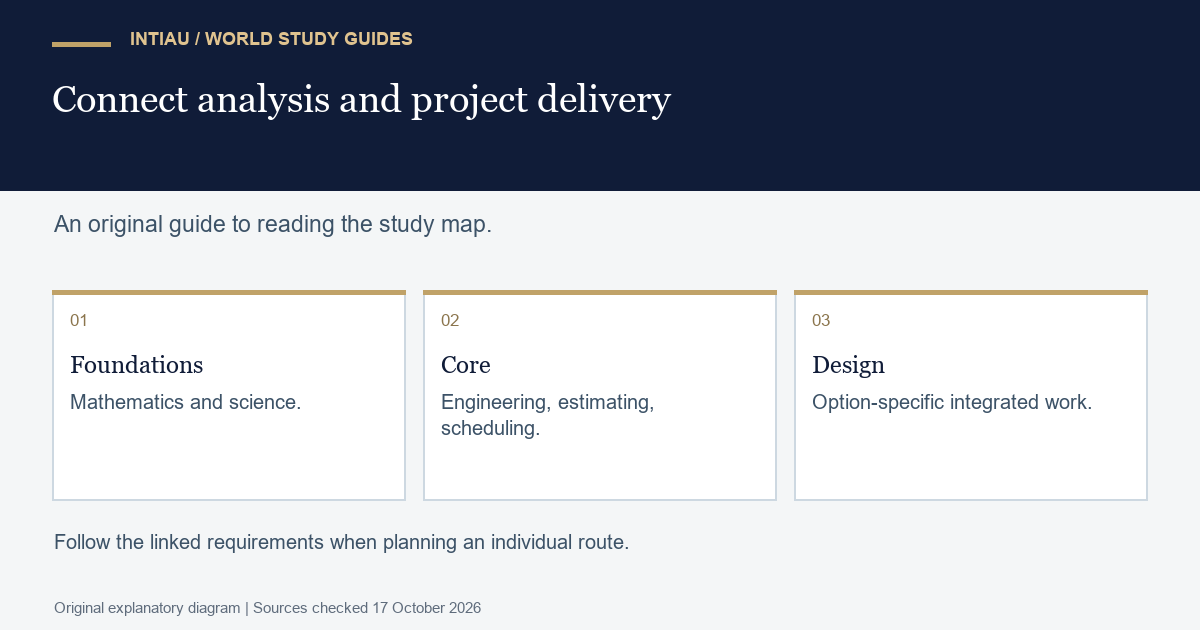
| Preparation | Calculus, chemistry and physics. | Quantitative foundations for engineering analysis. |
| Common core | Statics, materials, estimating and scheduling. | Connect physical constraints with the organisation of work. |
| Option | Building, electrical, infrastructure or mechanical. | Compare the actual technical electives. |
| Integration | Construction Engineering Design I and II. | Read the final design work alongside earlier preparation. |
The official degree catalogue provides complete option plans and rules. This selective table does not establish a personalised sequence or permission to substitute one option’s course for another.
Read a real cost-engineering course
CONE4220 Construction Cost Estimating and Cost Engineering is a three-credit course with lecture and laboratory contact. It requires CONE2410 and CONE2510. Its published content ranges from conceptual to detailed estimates, covering materials, labour, equipment, contingency, overhead and markup. It also includes bid ethics, electronic quantity take-off, production rates, profitability, value engineering and life-cycle cost analysis.
The description is useful because it joins arithmetic with the decision that the arithmetic supports. A price per unit, a production assumption and a risk allowance are different parts of an estimate. Naming them separately makes a calculation easier to challenge and revise.
The official course record lists normal fall and spring offering, but does not publish a detailed assessment-weight table. A prospective student should request the appropriate offering’s syllabus rather than assume an examination or project percentage.
International admission has a separate evidence checklist
Iowa State’s current international instructions describe rolling admission and allow an application up to one year before the intended start date. Required academic records can be uploaded through the application system; official final records remain necessary after admission. Documents not in English require a certified English translation.
The international first-year requirements page specifies academic preparation, including mathematics, science and language study, and a minimum GPA equivalent to 3.0 on a four-point scale. Country-specific requirements determine equivalence. SAT or ACT scores are not required for admission. English-proficiency evidence remains a separate requirement.
These standing instructions were checked on 17 October 2026. They are not a guaranteed decision date or a course-specific offer. A sensible application file distinguishes evidence already supplied, documents still pending and conditions that appear only in an eventual offer.
Practise separating quantity, productivity and cost
Consider a fictional job requiring 240 units of work. A crew can complete 30 units per day, so the planned duration is eight working days. If the crew costs 900 per day, direct crew cost is 7,200. A second crew completing 40 units per day at 1,100 per day needs six days and costs 6,600.
The faster crew is cheaper under these assumptions, but that is not yet a complete estimate. Ask whether mobilisation, equipment, site access or quality controls differ. Identify the assumptions that could reverse the comparison before recommending an option. This original calculation is a study exercise, not a construction quotation or professional design.
Compare the UCT civil-engineering guide and practise reading a curriculum. Browse additional subjects in Courses.
Questions about the degree
Do the options share one credit total?
No. Check the chosen option’s published total.
Does CONE4220 only teach a final price calculation?
No. Its description also includes estimating methods, production rates, ethics and life-cycle cost.
Does rolling admission guarantee an immediate decision?
No. It describes the application process, not a guaranteed response time or offer.
Related guides
View the curriculum diagram