UCL is independent from INTIAU; its Infrastructure Planning, Appraisal and Development MSc is based in Bloomsbury, London.
Infrastructure decisions extend beyond designing an individual asset. A project must respond to a need, fit a wider system, secure resources and remain useful as circumstances change. This guide examines the programme through three published modules rather than equating an MSc in planning with a civil-engineering qualification.
Check the 2027 application window and the study mode
The September 2027 page specifies an upper-second-class bachelor’s degree or equivalent as the ordinary entry requirement. Its application window starts 19 October 2026, after this guide’s 17 October check. Full-time study takes one calendar year.
Check the relevant deadline for your applicant category and chosen mode when that window opens. The page distinguishes visa and non-visa deadlines and also describes part-time and flexible study. Do not read the current “closed” indicator before the opening date as evidence that a future intake has already filled.
For a prospective applicant, the useful first question is whether the work of appraisal and planning matches your interests. A strong interest in infrastructure does not necessarily mean a desire to perform structural calculations. This degree’s named modules make policy, business cases and decision-making central objects of study.
Three connected areas of taught work
| Module | Published focus | Question to carry between modules |
|---|---|---|
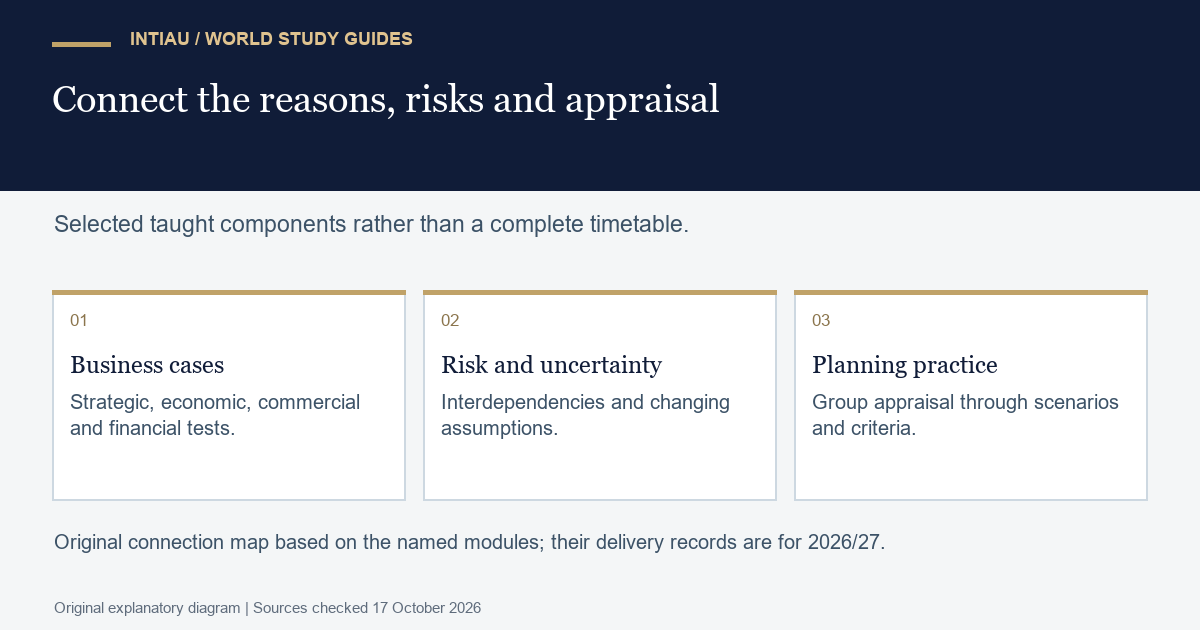
| BPLN0025 Business Cases for Infrastructure | Strategic, economic, commercial, financial and management cases. | Why should this intervention be pursued? |
| BPLN0026 Risk, Uncertainty and Complexity in Decision-Making | Interdependencies, risk management, forecasting and scenarios. | Which assumptions can change the recommendation? |
| BPLN0030 Major Infrastructure Planning Practice | Group appraisal of a recent or planned megaproject. | Can the reasoning be applied to a complex case? |
The table is a selective connection map, not the complete degree syllabus. Read the programme structure for required study, options and dissertation arrangements. The module catalogue below concerns 2026/27 delivery; its assessment detail should not be silently relabelled 2027/28.
What a business case course examines
BPLN0025 is a 15-credit module. Its description critically examines tools used to develop infrastructure business cases, including whether they adequately judge strategic fit, financial viability, commercial possibilities, management and value for money. It also addresses procurement, benefits management and the relationship between economic, environmental and social considerations.
A business case is therefore more than a positive financial total. The useful comparison is whether a programme teaches students to question the boundaries and purposes of an appraisal, as well as apply a technique. See the BPLN0025 description.
Risk and practice provide a different kind of evidence
The 15-credit BPLN0026 description considers risk, uncertainty and complexity across major infrastructure. It includes political and regulatory influences, stakeholder relationships, scenario planning and the limits of forecasting. It also treats technology as a possible source of risk as well as a response to it.
BPLN0030 is a 15-credit groupwork module using scenario planning and multi-criteria analysis. For 2026/27, its record lists 85% group activity and 15% coursework. The description was updated on 25 August 2026. Read its published delivery details alongside the risk module.
Try a small appraisal question
Imagine two fictional transport improvements. One shortens average travel time; the other improves reliability but barely changes the average. A single average-time figure cannot show which better serves a person who must arrive before a fixed appointment.
Define the decision and list the missing evidence: variation in journey time, affected users, cost and consequences of late arrival. Then state a scenario under which your preferred option changes. This original exercise is not a UCL assessment. It illustrates why a defensible recommendation needs both a measure and an explanation of what that measure leaves out.
Compare civil-engineering study at UCT and practise curriculum comparison, or browse Courses.
Questions about the MSc
Is this an undergraduate engineering award?
No. It is the Infrastructure Planning, Appraisal and Development MSc.
Does a business case examine only finance?
No. The named module also examines strategic, economic, commercial and management cases.
Are the quoted assessment weights guaranteed for 2027/28?
No. They are explicitly from the 2026/27 module record.
Related guides
View the curriculum diagram