Nanyang Technological University in Singapore is independent from INTIAU. This guide concerns its Bachelor of Science in Applied Physics, using the curriculum for students matriculating in 2026.
Applied physics is worth examining through the relationship between fundamentals and applications. Rather than looking only for an appealing technology in an elective list, ask which mathematical, experimental and theoretical preparation precedes it. Then distinguish the degree’s required core from optional specialisation.
Read the correct matriculation-year map
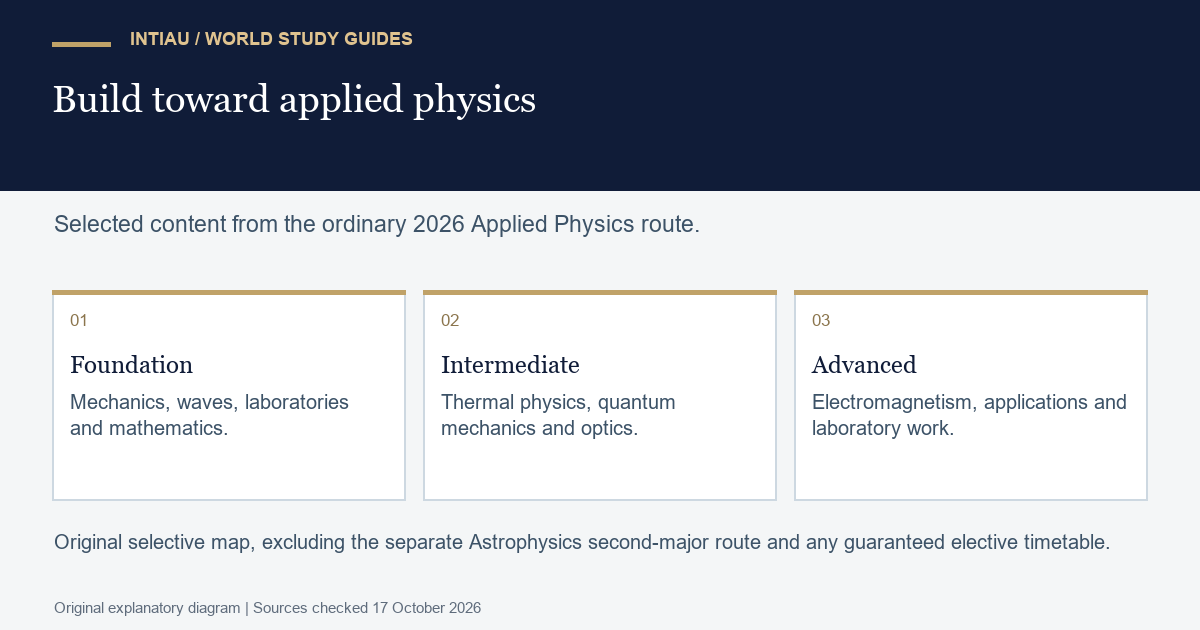
The 2026 Physics and Applied Physics curriculum gives the Applied Physics route a total of 131 academic units. The broad progression below selects examples rather than reproducing its complete course grid.
| Stage | Selected Applied Physics content |
|---|---|
| Foundation | Mechanics, optics and waves, laboratory work and mathematics |
| Intermediate | Thermal physics, quantum mechanics and Physical Optics |
| Advanced | Electromagnetism, quantum applications and advanced laboratory work |
Keep the matriculation year with any saved curriculum. Older pages can remain accessible and still contain different course codes or credit distributions. Also record whether a displayed course is prescribed, elective or shared with another degree. This prevents a comparison from quietly becoming a mixture of several routes.
Physical optics as an actual course example
The department’s course information identifies PH2301 Physical Optics as a three-unit Semester 2 course. It covers electromagnetic-wave phenomena including polarisation, interference and diffraction, and names PH1105 as its prerequisite.
The same course list describes PH3602 Photonics through optoelectronic systems, devices and optical communication. It requires PH2101 and PH2301. This is evidence of a specific prerequisite relationship, not a claim that every Applied Physics student takes every listed elective.
The distinction is practical. A student interested in optical devices can trace what must be understood before the application course. Another student can use the same method for a different interest without assuming that a technology-oriented title eliminates the need for mathematical physics. Course descriptions establish subject scope; they do not by themselves establish the number or format of assessments.
Original exercise: identify the missing experimental check
A fictional optical detector gives readings of 100 units without a filter and 40 units with one. The measured ratio is 0.40. A student writes, “The filter transmits exactly 40% of the light.” That conclusion assumes the detector response is linear, the illumination is unchanged and background signal is negligible.
Suppose a separately measured background is 10 units in both conditions. Subtracting it gives 90 and 30 units, so the corrected ratio is one-third, approximately 33.3%. The original 40% ratio describes the raw readings, not the background-corrected estimate. Neither calculation establishes wavelength-independent transmission.
A good, carefully qualified answer states the two ratios with their assumptions and proposes the next measurement needed. For example, repeat the background measurement and test detector linearity over the relevant range. This original exercise connects optical behaviour, measurement and interpretation; it is not an NTU laboratory task or a prediction of its marking scheme.
Entry requirements and route boundaries
The official programme admission record lists Physics and Mathematics at H2 level for Singapore A-level applicants and at Higher Level for IB applicants. Other international qualifications require good senior-high-school grades in those subjects at equivalent level. Polytechnic applicants are subject to an SPMS admission test. These are qualification-specific requirements, not a universal test rule.
That admission page also contains an older curriculum labelled for matriculation from 2021. This guide uses its subject requirements but the separate 2026 map for curriculum; it does not assign an unverified 2027 deadline.
Compare the Bern physics guide and the prerequisite-map workshop. The Courses directory collects further programmes.
Three questions answered
Is this the Astrophysics second-major route?
No. The guide follows the ordinary Applied Physics route in the linked 2026 map.
Is Physical Optics a generic label invented for this guide?
No. PH2301 is the department’s named course, with a published topic description and prerequisite.
Do all qualification groups have the same admission test?
No. The cited test condition is attached to the polytechnic-diploma route.
Related guides
View the curriculum diagram