Nanyang Technological University in Singapore is separate from INTIAU; its Bachelor of Engineering (Environmental Engineering) is not an INTIAU programme.
Environmental engineering combines physical and biological processes with decisions about infrastructure. A useful curriculum comparison asks how scientific principles become design choices, rather than treating sustainability as one undifferentiated subject. NTU’s programme structure and linked course descriptions provide several levels of evidence, each with its own date and purpose.
Admission requirements depend on qualification
The programme’s admission page asks for mathematics and an accepted science subject in addition to NTU’s general requirements. For the International Baccalaureate, it specifies Higher Level mathematics and Higher Level physics, chemistry, biology or computer science. Singapore A-level applicants are shown corresponding H2 requirements. International and other qualifications have their own route.
Do not convert those requirements into a universal score or an offer prediction. Match your actual qualification to the relevant tab, then check the central application timetable for your intended intake. The programme page supplies standing requirements rather than a single dated deadline that applies to every applicant.
How the published degree is organised
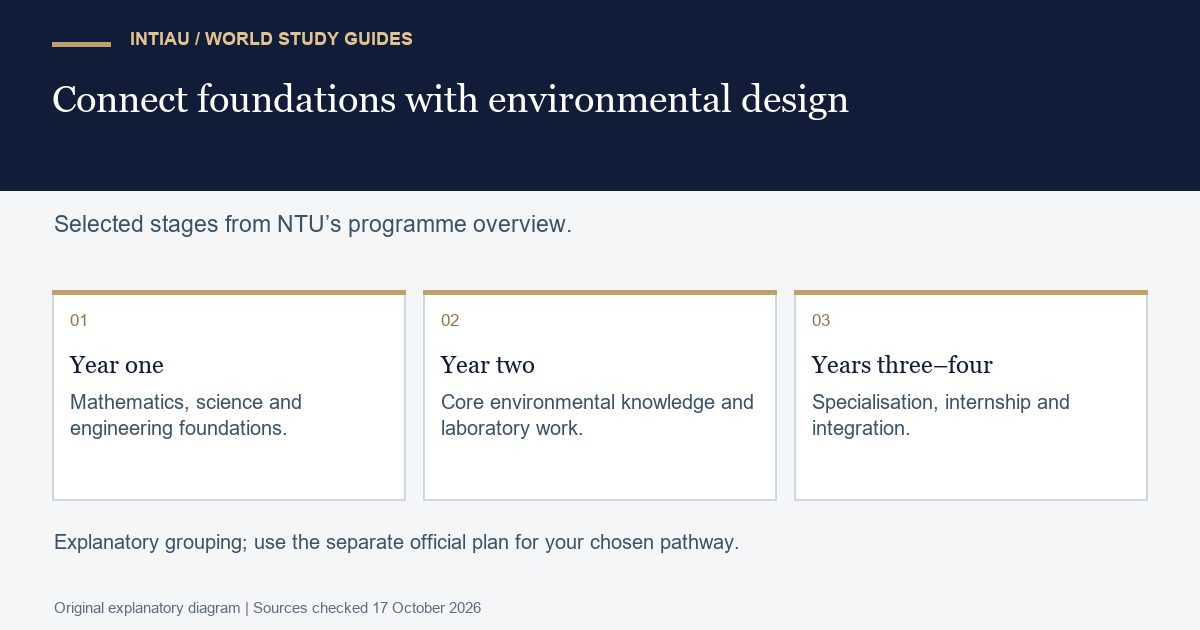
The standard structure shows 136 academic units: 83 in major requirements, 33 in the Interdisciplinary Collaborative Core and 20 in Broadening and Deepening Electives. Its overview places foundations in year one, core knowledge in year two, and specialisation and integration in years three and four.
| Stage | Selected published focus | Question for comparison |
|---|---|---|
| Foundations | Mathematics, science and engineering principles. | Which later processes depend on this preparation? |
| Core study | Environmental Chemistry; Geo-Environment and Soil Mechanics; laboratory work. | How are models connected with observations? |
| Later integration | Wastewater Engineering; Air Pollution Control Engineering; professional internship. | How are competing design constraints handled? |
The structure page links separate standard, double-degree and second-major plans; do not combine their requirements.
The course-content page labels pathway-specific units and changes between academic years. It lists EN1001 Environmental Chemistry as three academic units and includes EN2711 and EN2712 laboratory courses. The table above selects themes, not every required unit or a new semester timetable.
What the chemistry outline actually covers
NTU’s linked EN1001 outline identifies Environmental Chemistry and an expected implementation year of AY2019–2020. Its learning content includes thermodynamics, reaction kinetics, acid–base and carbonate equilibria, hardness, metal complexes, organic compounds and oxidation–reduction. These are published course themes from that document; its implementation label is not evidence that every assessment detail has been reissued for a 2027 cohort.
The stated learning outcomes ask students to solve chemistry problems and relate concepts such as oxygen and electron equivalents to environmental questions. Read the linked outline for its scope, then confirm the version used for an actual enrolment.
A course title alone cannot show how deeply a topic is treated. Compare the type of problem, the assumptions permitted and the evidence expected in an answer. A qualitative explanation of a treatment process and a numerical design calculation may develop related knowledge at different levels.
Try a concentration and flow check
In a fictional water-treatment example, a stream carries 40 milligrams per litre at 100 litres per minute. Its incoming load is 4,000 milligrams per minute. If treatment removes 75% of that load while flow stays constant, the remaining load is 1,000 milligrams per minute and the concentration is 10 milligrams per litre.
Now imagine that clean water doubles the final flow after treatment. The concentration becomes 5 milligrams per litre, but the remaining pollutant load is still 1,000 milligrams per minute. Dilution and removal are different claims. This original calculation illustrates why units and system boundaries matter; it is not an NTU assignment or a real treatment recommendation.
Compare the UCT civil-engineering curriculum and practise a prerequisite audit. Explore further subjects in Courses.
Questions about this degree
Are all 136 units major courses?
No. The published total includes major, interdisciplinary-core and broadening-elective components.
Does the standard plan also describe every second-major route?
No. NTU links separate pathway plans.
Is the chemistry document a newly dated 2027 syllabus?
No. The linked outline explicitly identifies an AY2019–2020 implementation year.
Related guides
View the curriculum diagram