The University of Otago is independent from INTIAU. Physics can be studied as a major in its three-year Bachelor of Science. This guide connects the published major requirements with a real experimental paper, rather than treating every physics paper as compulsory.
When comparing physics degrees, ask how mathematical methods, physical models and experiment meet. A programme may offer many advanced topics, but the useful question is which preparation makes those topics accessible and which practical work is actually required. A major also sits inside a wider degree, so its named papers do not necessarily account for every point needed to graduate.
Required levels and genuine choices
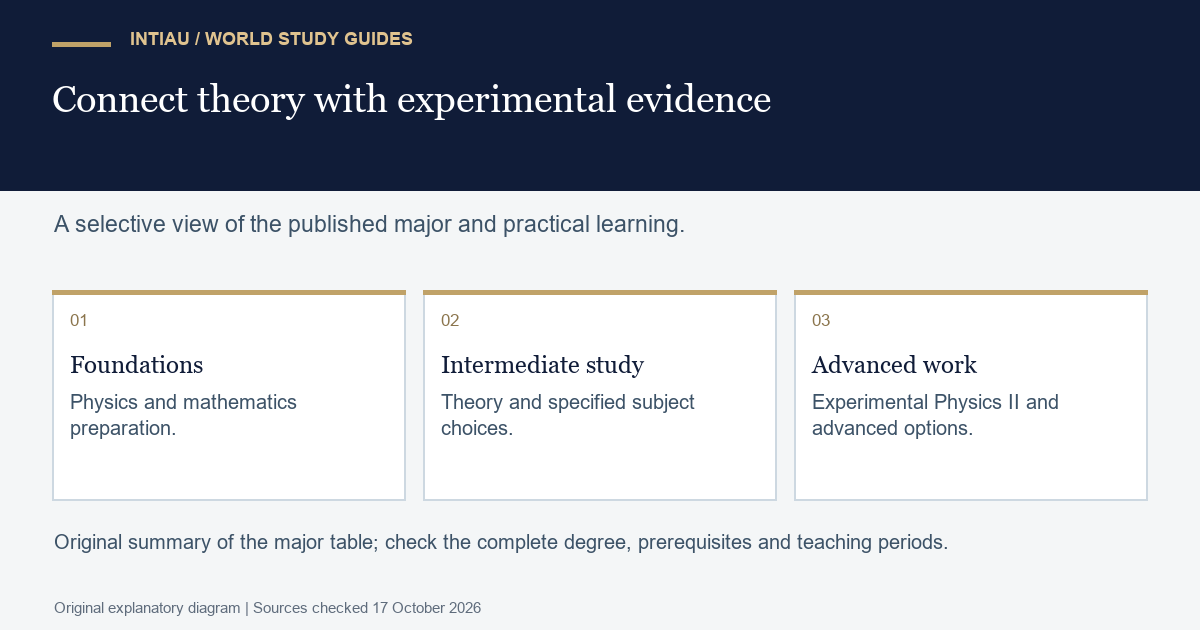
Otago’s Physics major table totals 360 points. It identifies foundation physics and mathematics, intermediate theory and choices, then advanced physics with compulsory experimental work. The table below condenses that structure; it is not a complete enrolment plan.
| Level | Selected published structure |
|---|---|
| 100 | Introductory physics plus MATH 130 and 140 |
| 200 | Classical and Quantum Mechanics; Electromagnetism; specified physics and mathematics choices |
| 300 | Experimental Physics II and three specified advanced options |
The major lists PHSI 282 as one intermediate choice, alongside Environmental Physics or Engineering Thermodynamics. Advanced choices include quantum, mathematical, thermal, wave and computational physics. Additional points complete the degree. Course availability and prerequisites must be checked alongside these major rules.
What experimental physics requires
The PHSI 282 Experimental Physics I record provides both 2026 and 2027 information. It is an 18-point, on-campus Semester 1 paper. Its themes include electricity and magnetism, optics and lasers, thermal processes and atomic physics. Published outcomes include designing an experiment, using measurement apparatus, keeping a laboratory notebook and analysing errors.
Its prerequisite is one of PHSI 131, 132 or 191, with MATH 130 required previously or concurrently. The outcomes also name basic data analysis in Matlab. These details let you distinguish a practical paper from a lecture course that merely discusses experiments.
A helpful comparison sheet records three things separately: what is measured, how uncertainty is represented and how an interpretation could be challenged. Software familiarity alone does not demonstrate all three. Equally, a successful apparatus setup does not establish that a measurement answers the intended scientific question.
Original exercise: precision and disagreement
Two fictional measurements of a length are 10.0 ± 0.2 centimetres and 10.5 ± 0.2 centimetres. Treat the stated intervals as simple bounds for this exercise. They span 9.8–10.2 and 10.3–10.7 centimetres and do not overlap. Averaging them to 10.25 centimetres does not explain their disagreement.
Before combining results, check whether both measured the same endpoints, used the same calibration and were recorded under the same conditions. Record the original values rather than deleting the less convenient result. A reasonable next step is to repeat the measurement with a defined protocol and a reference object. The aim is to investigate a possible systematic difference, not to make the notebook look tidy.
This original example is not an Otago assignment. It illustrates why an experimental curriculum should be read for measurement and reasoning outcomes, not only for its list of apparatus or physical phenomena.
Application route and preparation
International applicants should follow Otago’s official application instructions and select the qualification and major when applying online. Academic entry and English-language evidence are separate checks. This guide does not infer a future closing date from a general application page.
Use the Bern physics guide for a different degree structure and the curriculum-reading workshop to compare requirements. Other subjects are collected in the Courses directory.
Three questions answered
Is every advanced physics paper compulsory?
No. The major specifies Experimental Physics II and a choice of three papers from its advanced list.
Is PHSI 282 only a theoretical course?
No. Its published outcomes include experiment design, apparatus use, notebook practice and uncertainty analysis.
Does a major table replace degree advising?
No. Check prerequisites, teaching periods and the remaining degree points before committing to an enrolment plan.
Related guides
View the curriculum diagram