The University of Plymouth is independent from INTIAU. Its MSc Coastal Engineering specification (September 2026) requires 180 Level 7 credits, including summer study.
Compare this degree through three different questions: what coastal processes must be understood, how a design will be tested, and what evidence a research project must produce. Treat those questions separately. A convincing numerical result cannot rescue a design based on the wrong environmental assumptions, while a feasible design still needs a clear account of its limits.
A published structure, with an edition boundary
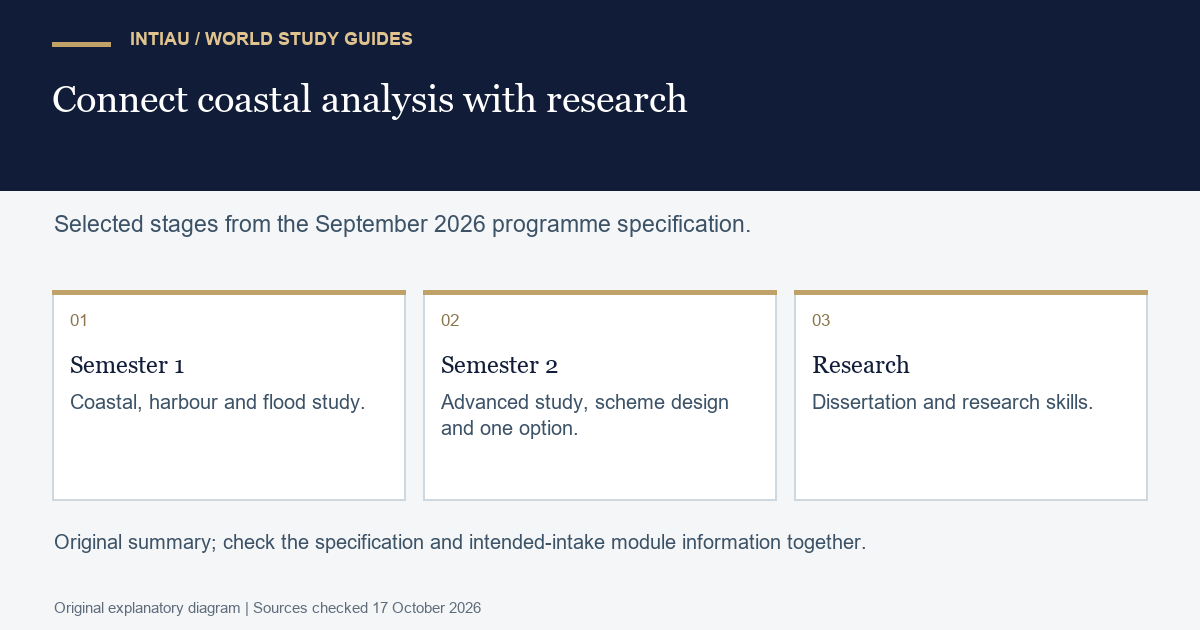
The table condenses the September 2026 specification. It is not a timetable for an unannounced later intake.
| Stage | Published components |
|---|---|
| Semester 1 | Coastal and Offshore Engineering; Port & Harbour Engineering; Flood Risk and Modelling |
| Semester 2 | Advanced Coastal Engineering; Sustainable Engineering Scheme Design; one option |
| Research | MSc Dissertation and Research Skills: 60 credits |
When comparing a later offer with this structure, check module codes as well as titles. A renamed component need not have identical assessment or delivery. Also distinguish a module available as an option from a component every student must complete. That distinction prevents an attractive specialist topic from becoming an assumed personal study plan.
What the named module descriptions explain
The current course page describes COUE508 as modelling waves, currents and sediment transport. COUE506 covers port and harbour environmental loads, operation and layout design. Its displayed assessment is half coursework and half examination. Module information may change for a later entry year.
These are complementary kinds of evidence. A model is a controlled representation of a system; a layout is a design decision made under several demands. In your comparison notes, ask which assumptions would make a model unreliable, and which competing requirements would make a layout choice difficult. The value lies in connecting those questions, rather than merely collecting software or module names.
Original exercise: compare two design statements
Consider a fictional harbour study. A team reports that a barrier reduces a modelled wave-height measure from 1.20 metres to 0.84 metres. The reduction is 0.36 metres, or 30% of the original value. A second team writes that its design “improves harbour safety by 30%”. These statements are not equivalent: a reduction in one model output does not directly quantify overall safety.
Write a better conclusion in two parts. First state the measured result and its denominator. Then name the checks still needed: the input conditions used, sensitivity to alternative conditions, navigation requirements and the consequences elsewhere in the study area. Do not insert a numerical allowance without evidence. A suitable answer is that the modelled measure fell by 30% under the tested conditions, while suitability for the harbour remains a broader design question.
For an independent research proposal, add an observation capable of challenging the preferred design. If every proposed measurement could only confirm it, the study is poorly framed. This exercise is original preparatory reasoning, not a Plymouth assignment or a professional design method. Keep the numerical output beside its assumptions so another reader can reproduce the comparison and challenge the interpretation.
Entry and application route
The published entry guidance seeks at least a 2:2 honours degree in engineering or a physical-science subject, with geography, environmental science and physics given as examples.
International applicants can use the university’s postgraduate taught application guidance, including its direct application route. Check the current course and document requirements for the intended intake; this guide does not assign an entry year to an undated deadline.
For related reading, compare the UCT civil engineering curriculum and the curriculum-reading workshop. Further subject guides are in the Courses directory.
Three questions answered
Does the published year include summer study?
Yes. The September 2026 specification includes summer study within the one-year programme.
Is the module list a guaranteed later-intake syllabus?
No. Compare the dated specification with the module information accompanying your intended intake.
Does the worked percentage establish a safe harbour design?
No. It describes one fictional model output; safety and suitability require additional evidence and design criteria.
Related guides
View the curriculum diagram