Texas Tech University is independent from INTIAU. Its Bob L. Herd Department offers the BS in Petroleum Engineering in Lubbock. This guide examines the programme’s published subject content and the difference between university application and progression into specialist study.
A petroleum-engineering comparison should follow the physical system and the decision being made. Reservoir behaviour, production equipment and project economics answer different questions. Treating them as interchangeable “energy courses” hides the specific preparation each requires.
What the current programme record establishes
The university’s programme record describes a four-year, 133-credit degree.
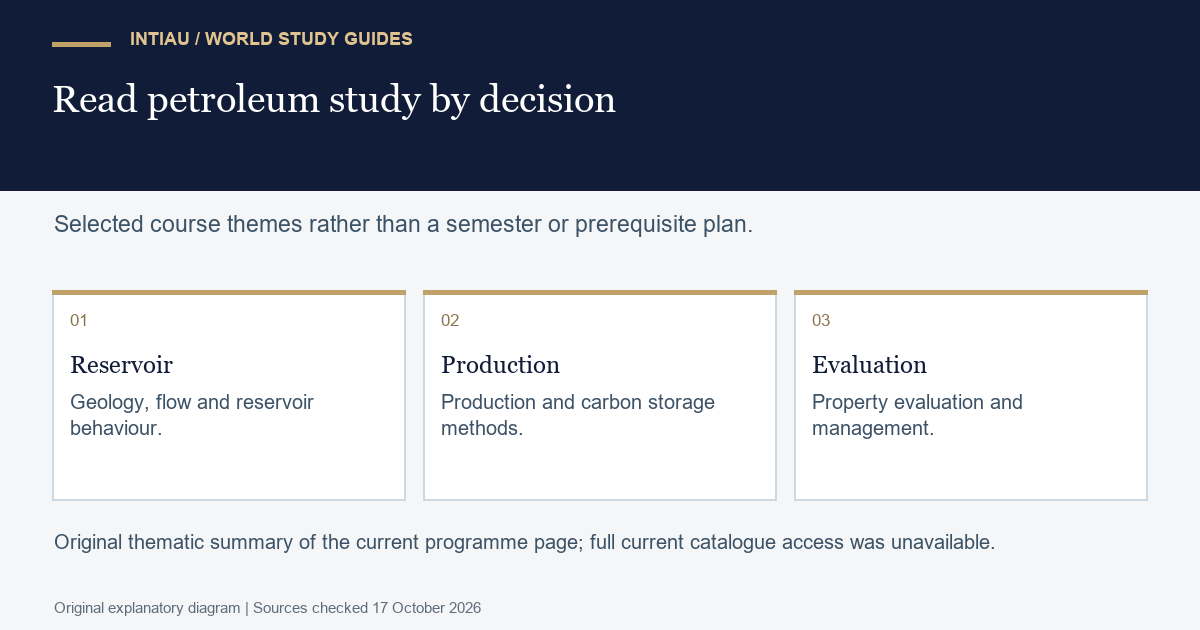
The current catalogue linked there was unavailable to this review. The following table is a thematic selection, not a verified semester sequence.
| Question | Named course example |
|---|---|
| What contains the resource? | PETR 2324 Geology |
| How does the reservoir behave? | PETR 3306 Reservoir and Carbon Utilization/Storage Engineering |
| How is production managed? | PETR 4303 Petroleum Production and Carbon Storage Methods |
| How is a property evaluated? | PETR 4300 Petroleum Property Evaluation and Management |
PETR 3306 covers flow through porous media, reservoir types, recovery, material balance and performance.
This is a published course-content example; it does not establish a particular 2027 assessment, project partner or teaching schedule.
Engineering reasoning beyond a course title
The department’s student outcomes include engineering problem formulation, design with wider constraints, communication, ethical judgement, teamwork and experimentation. These describe intended capabilities, rather than guaranteed employment or professional registration for every graduate.
Use those capabilities to examine evidence. When an exercise produces a reservoir estimate, what observations support it? When a design is preferred, which constraints made it preferable? When economics changes the decision, which assumptions changed? A useful study comparison keeps technical calculations and professional judgement connected without pretending they are the same skill.
Original exercise: recoverable quantity versus certainty
Consider a fictional screening calculation with 10 million units initially in place and an assumed recovery fraction of 25%. The corresponding estimate is 2.5 million units. If the plausible fraction instead ranges from 20% to 30%, the estimate spans 2 to 3 million units. This range comes only from the stipulated fraction; it does not include uncertainty in the amount initially in place.
Now compare two statements: “the estimate is 2.5 million units under this assumption” and “the project will recover 2.5 million units”. Only the first follows from the calculation. To improve the analysis, identify which observations could narrow the recovery range and which independent assumptions affect the starting quantity.
A sound answer preserves the range, units and assumptions, then separates physical uncertainty from any later economic decision. This is an original educational example, not a reserve classification, investment forecast or Texas Tech assignment.
For a comparison notebook, add a column identifying the decision each calculation supports. A physical estimate may inform a design choice, but an economic recommendation also needs costs, timing and a stated decision criterion. Leaving an unknown cell blank is more honest than treating it as zero or assuming it will favour the preferred project.
Application and progression need separate checks
The undergraduate application page separates domestic and international application routes. Use the appropriate route and its current document requirements; this guide does not infer a cohort deadline from general navigation.
Departmental advising information discusses foundational coursework and a 3.0 institutional GPA for entry into Petroleum Engineering, but explicitly references students entering in fall 2022. Confirm current progression rules with the department rather than assuming that historical cohort wording governs a new applicant.
Compare the Imperial mechanical engineering guide for another engineering structure and the prerequisite-map workshop for a way to separate entry from progression. More guides appear in the Courses directory.
Three questions answered
Is the table a current semester plan?
No. It groups selected courses from the accessible programme page by the questions they address.
Does university admission settle specialist progression?
No. Check the programme’s current progression requirements separately; the cited departmental detail includes an older cohort reference.
Does the example predict an actual recovery outcome?
No. It demonstrates how a stated assumption affects a fictional estimate and its range.
Related guides
View the curriculum diagram