Colorado School of Mines is independent from INTIAU; its BS in Geophysical Engineering requires 126 semester hours in the 2026–2027 catalogue.
This is a useful degree to examine through the chain from a physical signal to a geological interpretation. A measurement does not display its explanation directly. Computing, field practice and uncertainty analysis matter because different models can sometimes account for similar observations.
From foundations to field and design work
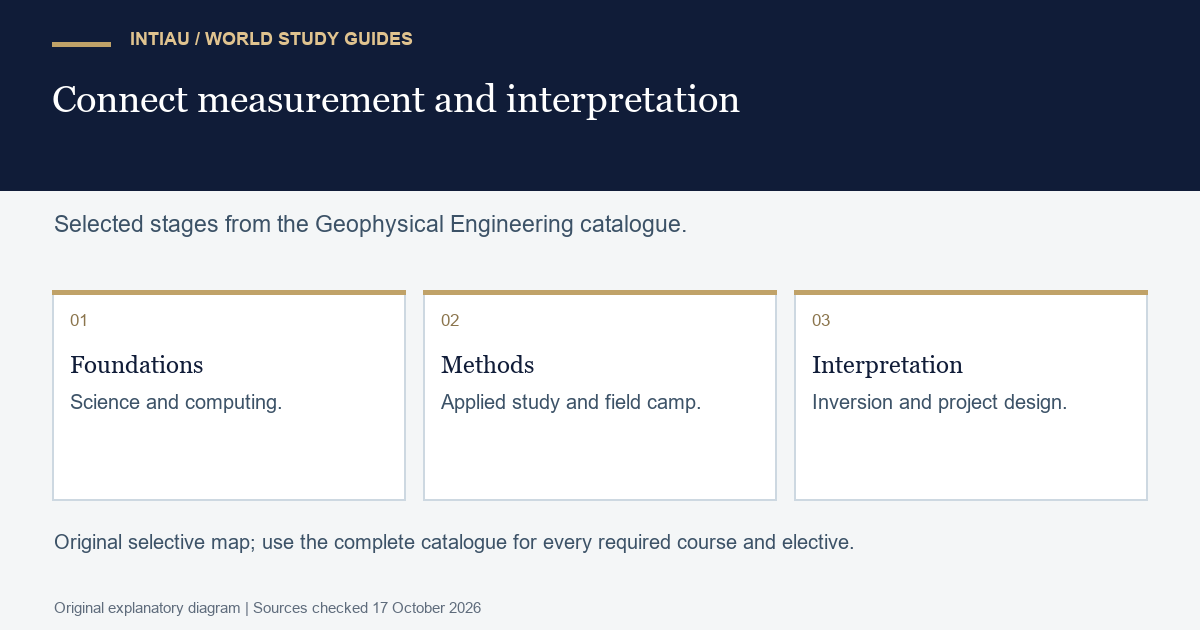
The official programme catalogue gives the full requirements and recommended sequence. This table selects the main stages rather than replacing the degree audit.
| Stage | Selected requirements |
|---|---|
| First year | Calculus, chemistry, physics, Earth systems and computing |
| Second year | Introduction to Geophysics and Geophysical Data Analysis |
| Third year and summer | Applied Geophysics, signal processing and Geophysics Field Camp |
| Senior study | Geophysical Computing, Inversion and Geophysics Project Design |
In comparing this sequence, keep acquisition, processing and interpretation separate. A field course is evidence of work with observations; a computing course addresses tools for transforming them; an inversion course concerns recovering a model from data. Those roles can reinforce one another without being interchangeable.
What Geophysical Data Analysis actually covers
The catalogue entry for GPGN268 Geophysical Data Analysis specifies three semester hours and CSCI128 as its prerequisite. Students use software on open-ended geophysical projects, including processing, modelling and visualising data. The description explicitly addresses uncertainty, data errors and their effects on interpretation and decisions.
The course also integrates teamwork and communication with obtaining the information needed to solve a problem. Its scope therefore extends beyond reproducing a plot: the analyst must decide what information is missing and explain how limitations affect the result.
This is a strong point for comparing another programme. Look for an actual course description that explains how uncertainty is handled, rather than assuming that the presence of a programming language or field instrument proves the same learning outcome.
A small mismatch between a model and the observations can still conceal an unrealistic assumption. Keep the numerical fit and the physical explanation as separate lines in your notes, then assess whether both are defensible.
Original exercise: two equally plausible models
Suppose a simplified survey measures a response of 12 units. Model A predicts 11.8 and Model B predicts 12.2. If the exercise stipulates a measurement uncertainty of ±0.5 units, both predictions lie within that interval. Choosing A because its value is lower would not be justified by these observations.
Propose a second measurement before deciding between the models. In this fictional example, let A predict 6 units at a second location and B predict 9. A measurement with uncertainty ±0.5 could distinguish these predictions more effectively than simply repeating the first location. The key is not that two measurements always solve an inverse problem; it is that measurement design should respond to the ambiguity in the models.
Write the conclusion in conditional form: both models fit the first observation within the stated tolerance, and a second location is proposed because their predictions diverge there. Preserve the uncertainty and alternative explanation. This original reasoning exercise is not a Mines assignment or a method for certifying a real subsurface investigation.
Fall 2027 application route
Mines’ first-year admissions page explicitly identifies fall 2027 applications. It accepts the Golden Application or Common App without preference, requires high-school transcripts and describes admission as test optional. Applicants should distinguish required materials from strongly encouraged responses and recommendations.
Use the Lausanne geosciences guide for a different Earth-science structure and the curriculum-reading workshop for a comparison method. Further programmes appear in the Courses directory.
Three questions answered
Is the table a complete degree plan?
No. It selects stages from the catalogue; the complete plan includes additional core and elective requirements.
Does GPGN268 explicitly address uncertainty?
Yes. The course description includes data limitations, error analysis and consequences for interpretation.
Does Mines prefer one of its two application platforms?
No. The first-year page states no preference between the Golden Application and Common App.
Related guides
View the curriculum diagram