University College London (UCL) is independent from INTIAU. Its Chemical Engineering BEng is a three-year, full-time degree based in London, Bloomsbury. This guide separates the September 2027 application record from the published 2026/27 module descriptions.
Chemical engineering connects a process calculation with equipment, measurement and design decisions. To compare courses meaningfully, follow one idea across those levels. A material balance may begin as a classroom calculation, become a test of experimental measurements, and later constrain the design of a complete plant.
Progression from foundations to a plant design
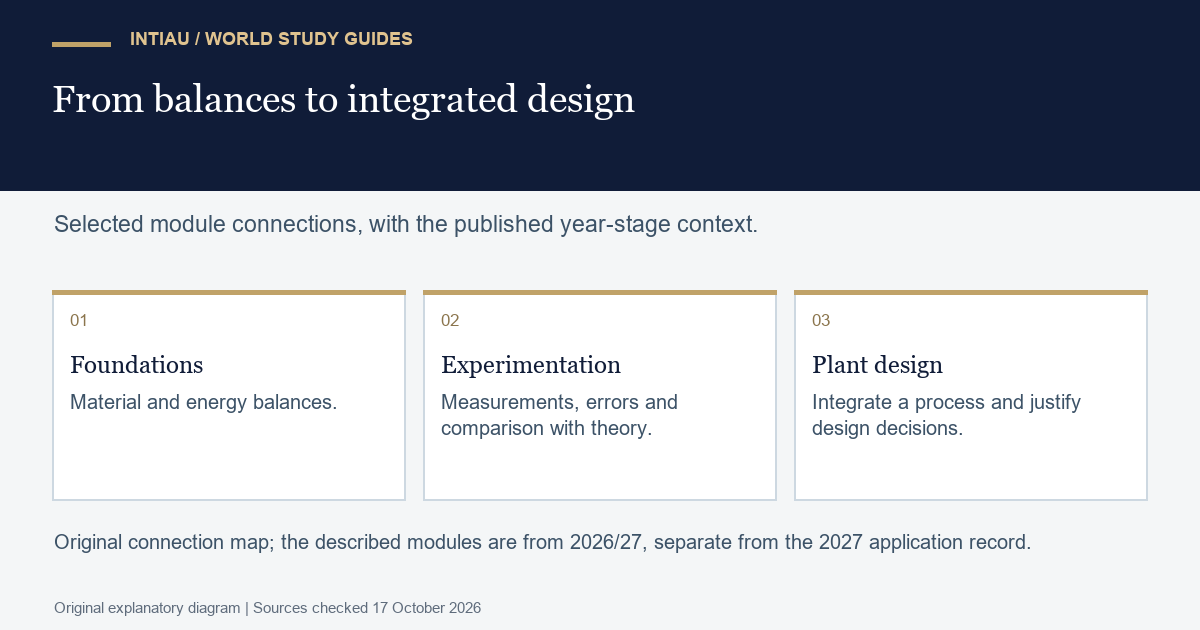
UCL’s 2026 entry curriculum description progresses through foundations, experimentation and a group process-plant design. It specifies 120 credits annually and 360 for the BEng (Hons). The module list is indicative, rather than an unconditional promise of later availability.
| Published stage | Selected component | What to inspect |
|---|---|---|
| Year 1 | Introduction to Chemical Engineering | Material and energy balances, process variables and safety |
| Year 2 | Engineering Experimentation | Measurement, error, equipment and interpretation |
| Year 3 | Process Plant Design Project | Integrated design and justified decisions |
Read the actual module content
The 2026/27 record for CENG0002 assigns 15 credits. It introduces balances with and without reaction, multiphase systems and energy calculations. Its displayed assessment combines 30% coursework with a 70% examination.
CENG0008, also 15 credits, develops safe equipment assembly, flow and pressure measurement, comparison with theory, error analysis and teamwork. Its examples include pumps and stirred vessels. A measurement that disagrees with a calculation therefore becomes something to investigate, rather than simply a number to discard.
The 30-credit CENG0016 asks students to integrate a sustainable plant design, work with incomplete or conflicting information, and justify choices among competing objectives. The record concerns a design project, not a guarantee of constructing or operating an industrial plant.
Its published learning aims include understanding interactions between process units and presenting a flowsheet with stream data. This makes the project a useful checkpoint for integration: a sound calculation for one unit must remain compatible with the rest of the process.
In a comparison notebook, keep a column for those interfaces. Record which earlier calculations feed later decisions and which evidence could force a redesign. That is more useful than treating every module as an isolated subject.
Original exercise: close a simple balance
Imagine an unreactive mixing process receiving 100 kilograms per hour of a stream containing 20% dissolved material. A second feed is pure water at 50 kilograms per hour. Assume steady operation, no loss and the same mass-fraction convention throughout. The outgoing flow is 150 kilograms per hour; dissolved-material flow remains 20 kilograms per hour. Its mass fraction is therefore 20/150, approximately 13.3%.
Now suppose a sample is reported as 16%. Do not change the input numbers until the balance agrees. List possible explanations first: a measurement error, an unrecorded stream, incomplete mixing, changing inventory or a different concentration basis. The assumptions create testable questions. For example, sampling at another location can test whether the collected liquid represents the outlet.
This is a simplified original exercise, not a UCL assessment. Its purpose is to connect calculation, experiment and design: a larger design should make its assumptions visible and show how contradictory evidence would be handled.
September 2027 application route
The 2027 course record directs applications through UCAS, code H800. It lists AAA with Mathematics and Chemistry and an equal-consideration deadline of 13 January 2027 at 18:00 UK time. UCL states that the department does not interview or test candidates. Other qualifications and contextual conditions require their own published criteria.
When comparing study routes, use the Imperial mechanical engineering guide for another design-focused programme and the prerequisite-map workshop to trace preparation. Browse the Courses directory for further disciplines.
Three questions answered
Are the module descriptions the 2027 timetable?
No. They are dated 2026/27 records used to explain selected content. Check the curriculum supplied for your entry cohort.
How large is the plant design project?
The published CENG0016 record assigns it 30 credits.
Does the standard A-level route require Chemistry?
Yes. The September 2027 record requires Mathematics and Chemistry within its stated AAA offer.
Related guides
View the curriculum diagram