The University of Illinois Urbana-Champaign is independent from INTIAU. Its BS in Materials Science and Engineering connects the structure, processing, properties and performance of materials. This guide examines that relationship through the degree requirements and a dated introductory course example.
A useful comparison begins with what a student must explain. Naming a material is not enough: why does it behave as observed, how did processing affect it, and what would make it appropriate for a particular use? Those questions help distinguish a materials curriculum from a general collection of chemistry and engineering electives.
Read the required structure before choosing a focus
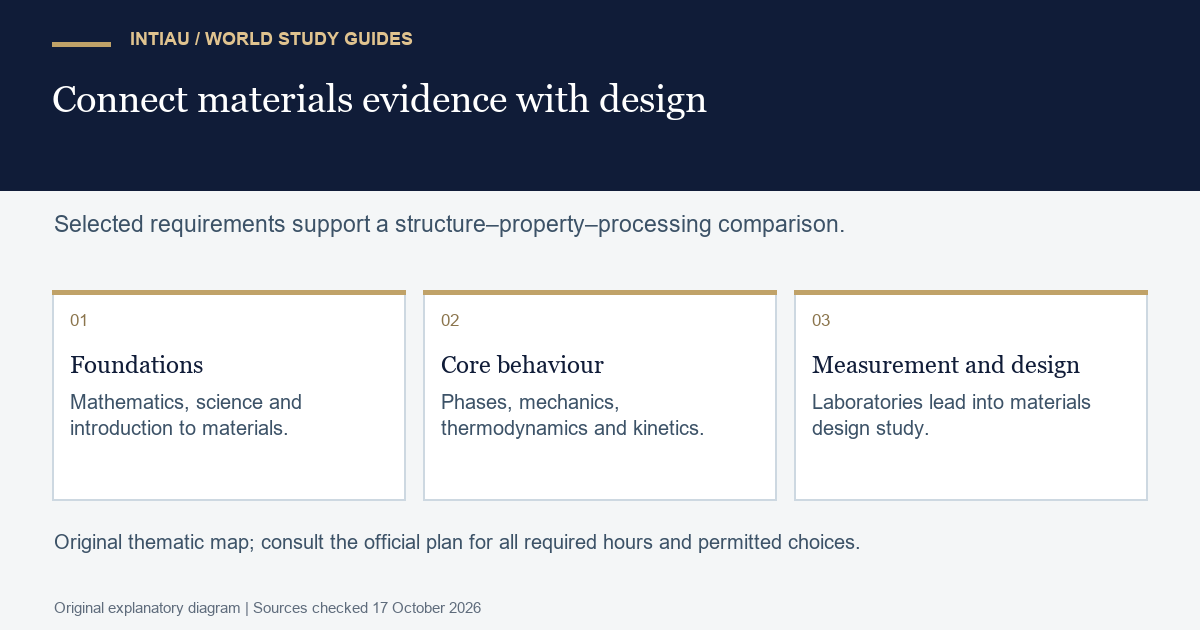
The 2026–2027 degree catalogue specifies 128 hours and a minimum overall GPA of 2.0. It combines university requirements with mathematics, science and materials study. Its named core includes phases, mechanics, laboratories, thermodynamics, kinetics and design.
The department describes foundational study in the first two years, core materials courses in the third and a more focused fourth year. Its bachelor’s overview distinguishes biomaterials from the broader materials route. Read the appropriate plan rather than combining attractive elements from both.
| Area | Selected requirements or role |
|---|---|
| Introduction and foundations | MSE 182 and the supporting mathematics and science requirements |
| Behaviour and measurement | MSE 201 Phases of Matter; MSE 206 Mechanics for MatSE; MSE 307 and 308 laboratories |
| Advanced principles | MSE 401 Thermodynamics of Materials; MSE 402 Kinetic Processes in Materials |
| Design | MSE 494 Materials Design Thinking and MSE 495 Materials Design |
What MSE 182 actually introduces
The Fall 2026 MSE 182 record assigns two hours to Introduction to MatSE. It uses structure–property–processing relationships, case studies, laboratory demonstrations and design-team analysis or synthesis. The listed section is intended for entering freshmen and restricted to Grainger Engineering; a catalogue description is not permission for any student to enrol.
The course’s combination of explanation and design suggests a practical reading strategy. For each later requirement, write down the phenomenon studied, the evidence used to examine it and the decision that evidence could support. This creates a comparison more informative than counting laboratory titles or assuming every demonstration involves the same amount of independent experimental work.
Original exercise: a materials decision with missing evidence
Suppose two hypothetical sheet materials satisfy an initial strength target. Material A has density 2.5 units and B has density 7.5 units. For equal volume, B has three times A’s mass. That calculation alone does not establish that A is the better design choice: equal-volume specimens may not meet the same stiffness, durability or manufacturing constraints.
Build a decision table with four rows: required function, property evidence, processing route and failure condition. Enter only the density relationship as known. Mark the other cells unknown until evidence is supplied. A defensible conclusion is that A offers a mass advantage at equal volume, while suitability remains unresolved. It would be misleading to rewrite this as “A is three times better”.
Next propose one comparison that could change your decision, such as testing both under the same loading and environmental conditions. Define the measurement and acceptance criterion before seeing a result. This original exercise illustrates the difference between a property comparison and a complete engineering recommendation; it is not an Illinois assignment.
First-year application preparation
Illinois’s first-year requirements call for at least 3.5 years of mathematics, including trigonometry or higher, for Grainger majors. Application materials include the self-reported academic record and English-proficiency scores when required; applicants may choose whether to report admission-test scores. This current requirements page does not establish a specific 2027 deadline.
For a wider comparison, use the Imperial mechanical engineering guide to examine a different design emphasis and the curriculum-reading workshop to organise requirements. Further guides appear in the Courses directory.
Three questions answered
How many hours does the published BS require?
The 2026–2027 degree record specifies 128 hours.
Is the course table a complete four-year timetable?
No. It highlights selected requirements. Use the official plan for all requirements, prerequisites and scheduling.
Can a transfer applicant assume access to the listed MSE 182 section?
No. Its Fall 2026 section information specifically identifies entering freshmen and enrolment restrictions.
Related guides
View the curriculum diagram