Charles University’s Liberal Arts and Humanities is a separate institution’s bachelor’s programme, not an INTIAU programme or partnership. The Faculty of Humanities describes a three-year, full-time route taught in English.
An open curriculum still has structure. The useful comparison is how required examinations, elective groups and a thesis hold a broad education together. This guide distinguishes that structure from the mistaken idea that any collection of interesting courses will satisfy a degree.
Map requirements before choosing electives
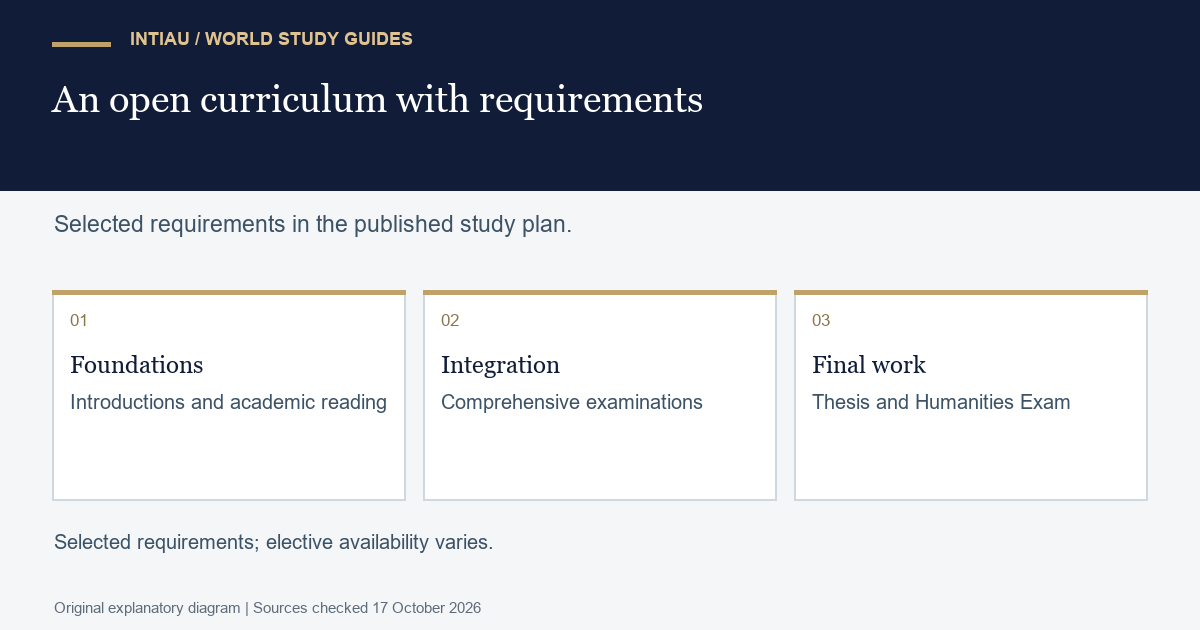
The study-plan page separates compulsory, elective and optional courses. The required sequence includes introductions, academic reading and writing, and comprehensive examinations in philosophy, social sciences and European history. Graduation requires the relevant groups, 180 credits, thesis defence and the Humanities Exam.
| Part of the route | Actual examples | Planning question |
|---|---|---|
| First-year foundations | Introduction to Anthropology; Seminar in Academic Reading and Writing | Which foundational requirements are compulsory? |
| Continuing requirements | Comprehensive examinations across three fields | What knowledge must be integrated beyond individual courses? |
| Final work | Diploma seminars, thesis defence and Humanities Exam | How does the elective route support an independent question? |
For a current example, the winter 2026–2027 elective list includes YBLS007, Introduction to Qualitative Methods in Social Sciences. Its outline covers research questions, sampling, ethics, data collection, coding and presentation, with interviews, focus groups and document analysis among the methods introduced.
The course is an example of available specialised study, not a promise that every elective runs in every term. Avoid copying someone else’s timetable without checking your own curriculum group and registration conditions. A course can be intellectually relevant yet fail to fill the requirement you intended.
Read the current applicant dates precisely
Checked on 17 October 2026, the faculty page lists 31 March 2027 for applications and 24 April 2027 for its stated online entrance examination date. Admission includes the required examination result and proof of completed secondary education; foreign qualifications require recognition.
The same page also contains an older 2026 document deadline and an obvious typographical error in one year range. Use the clearly labelled intake dates and the official application instructions, rather than treating every numeral on a mixed page as a future requirement. This guide does not infer an exemption, a test score or acceptance for an individual applicant.
Worked exercise: compare three explanations of one object
Imagine an entirely fictional neighbourhood museum displaying a repaired wooden chair. Its label records only that it was made in 1940, repaired in 1975 and donated in 2000. Draft one question in history, one in anthropology and one in philosophy. Then identify which information would be needed to pursue each.
A historical question might ask why repair was chosen in 1975. It could lead to household records or evidence of material availability, but the three dates alone do not answer it. An anthropological question might ask what meanings repair carried for the people who used the chair; an account from those people would differ from an assumption based on its appearance. A philosophical question might ask which changes would make it count as a different object.
These questions overlap without becoming interchangeable. A receipt could help date a repair but cannot settle a general criterion of identity. A philosophical argument about identity cannot establish who performed the repair. The strongest answer pairs each question with appropriate evidence or reasoning and acknowledges the missing information.
Produce a three-row question-and-evidence table, then write a proposed thesis question narrow enough to investigate. Score it for a clear object of inquiry, an appropriate method, a feasible scope and an honest limit. This original activity illustrates interdisciplinary reasoning; it is not a Charles University assignment or a substitute for its thesis requirements.
Questions about an open curriculum
Does “open” mean there are no compulsory requirements?
No. The study plan specifies compulsory work, elective groups and final requirements.
Does the named methods course define every elective?
No. It is one current listed example. Other courses have their own content and availability.
Can the three chair questions share one answer?
Not automatically. Each asks something different and needs evidence or reasoning suited to that question.
Official reading and related study
- Programme and 2027 admission information
- Detailed study plan
- Current essential electives and course outlines
Compare historical inquiry with the Durham history guide, and use the curriculum-reading workshop to distinguish requirements from options. More course and syllabus guides are available.
Related guides
View the study diagram