KU Leuven’s Bachelor of Arts in Philosophy is a separate institution’s programme, not an INTIAU programme or partnership. This guide concerns the three-year, 180 ECTS route, rather than its abridged alternatives.
Philosophy rewards precision about both arguments and programme names. Before comparing modules, establish which route matches your previous education. Then ask how historical study, systematic questions and writing practice support one another. A long reading list alone does not explain that relationship.
Read the programme through its learning paths
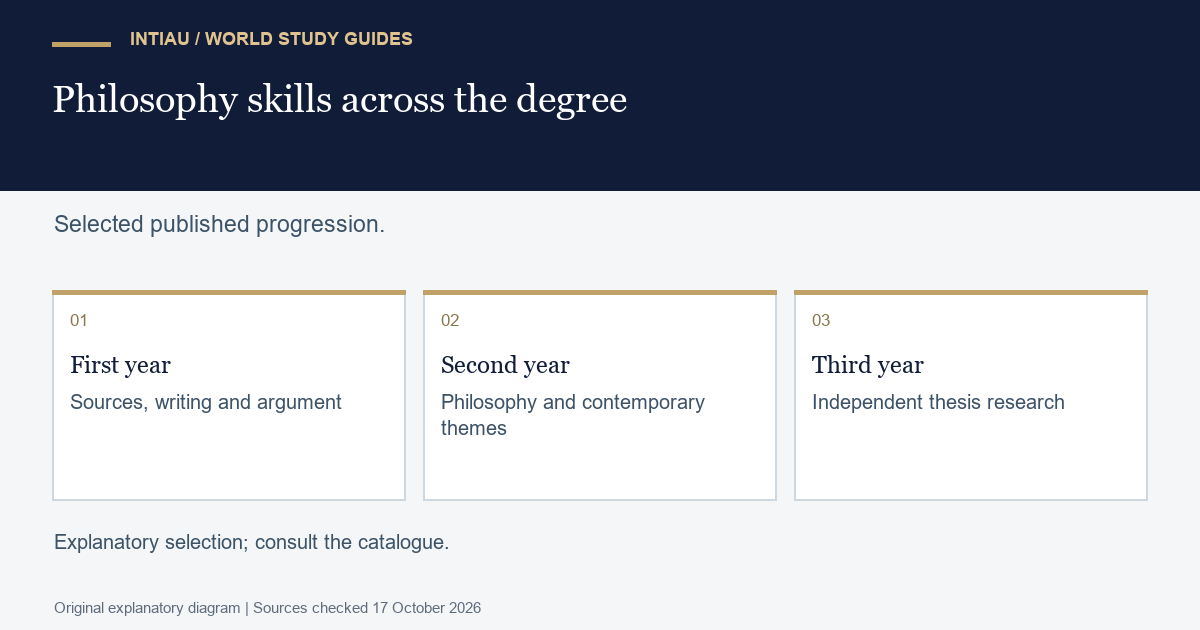
The published structure combines a common philosophy major with a minor. Its four learning paths cover history, systematic philosophy, philosophical expansion, and skills and research. The skills sequence moves from finding and using sources to broader thematic work and a third-year thesis.
| Stage or strand | Published example | Question for your comparison |
|---|---|---|
| First-year foundations | Logic; Ethics; Research and Writing in Philosophy | How are arguments practised and discussed? |
| Continuing study | Historical and systematic philosophy | How are texts placed alongside contemporary questions? |
| Research development | Third-year bachelor’s thesis | What independent question will you learn to defend? |
Research and Writing in Philosophy develops reading, speaking, writing, research and argumentation. A current assessment breakdown was not established here.
The overview warns that the programme can change annually. Use it to understand the design, then check the applicable official catalogue for the exact course combination. A title shared with a different university programme is not evidence of identical content or credit transfer. Likewise, a philosophy course listed in another degree should not be silently inserted into this one.
Distinguish eligibility from an admission decision
The Institute’s requirements say applicants who have completed secondary education may apply to the three-year programme. Complete applications are evaluated by the university and the relevant admissions board; published basic eligibility is not itself acceptance.
Checked on 17 October 2026, the Institute’s application page still gives the 2026–2027 cycle, with 1 March and 1 June deadlines for its specified applicant groups. Those dates are already past. The page says the academic year starts in September and that a February intake is unavailable.
Do not convert these historical dates into a guessed 2027 deadline. Identify the forthcoming cycle through the official application route, then confirm language evidence and required documents for your circumstances. This guide preserves the visible source boundary rather than advertising an unverified open application window.
Worked exercise: test an argument with a counterexample
Consider this original fictional library policy argument: “Every quiet room helps concentration. This room is quiet. Therefore every student who uses it will concentrate well.” Identify the change in the claim, and write a defensible alternative without denying the possible value of quiet space.
The first premise describes a helpful feature; the conclusion asserts a guaranteed result for every user. That does not follow. A student may be distracted by an unresolved task, fatigue or a difficult text even in a quiet room. The counterexample need only be possible to defeat the universal inference; it does not establish how often the policy succeeds.
A more careful conclusion is: “Providing a quiet room may remove one obstacle to concentration, but it does not ensure concentration for every user.” This retains the premise’s practical relevance while narrowing the conclusion. It also leaves a separate empirical question: how much difference does the room make under particular conditions?
Now reconstruct the argument in three numbered sentences using your own words. Mark each sentence as premise or conclusion, underline the universal words and propose one revision. Score the response for accurately representing the original, locating the unsupported step, offering a relevant counterexample and avoiding a new unsupported universal claim. This is an illustrative reasoning task, not a KU Leuven examination question.
Questions before choosing a route
Is the abridged programme interchangeable with this route?
No. The Institute lists separate abridged routes with different entry backgrounds and credit loads. This guide covers the 180 ECTS programme.
Does this page establish an open 2027 application window?
No. The application source checked here still stated 2026–2027 deadlines. Confirm the new cycle rather than reusing those dates.
Does finding a counterexample settle every policy question?
No. It can refute a universal claim, while questions about typical effects, costs and alternatives still require appropriate evidence.
Official reading and related study
- Programme identity and admission requirements
- Learning paths and named course descriptions
- Application cycle and route
Use the primary-evidence workshop when separating a text from commentary, and the curriculum-reading workshop when comparing requirements. Browse further course and syllabus guides.
Related guides
View the study diagram