NOVA FCSH’s Licenciatura em Tradução, at NOVA University Lisbon, is a separate institution’s programme, not an INTIAU programme or partnership. It spans three years, six semesters and 180 ECTS.
Translation study is more specific than general language improvement. To compare degrees, investigate the languages combined, the direction of translation, the types of text and the tools used. This guide explains the published curriculum structure without implying that every language option can be taken together.
Read language combinations alongside the course groups
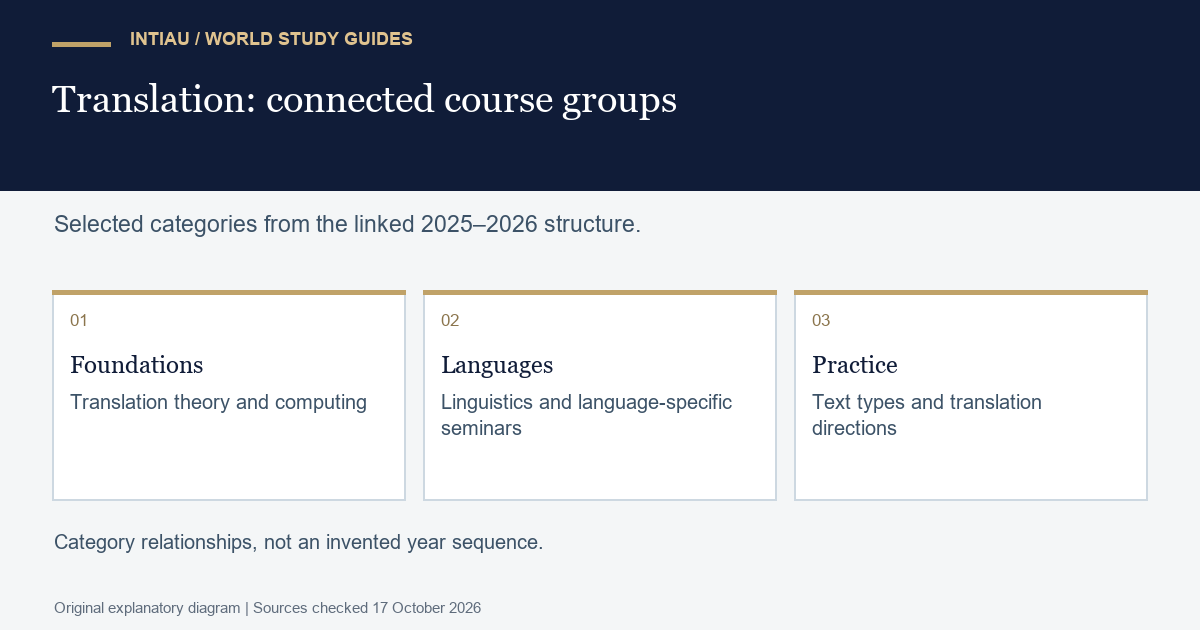
The programme offers combinations involving German, Spanish, French or English with Portuguese. Its published structure distinguishes compulsory units, complementary study and space in other degree programmes or a minor.
| Category | Actual examples | What to check |
|---|---|---|
| Compulsory foundations | História e Teoria da Tradução; Informática para a Tradução | How are translation decisions and tools introduced? |
| Language-specific work | Linguistics and translation seminars in the selected language | Which language is A and which is B? |
| Translation practice | Literary, technical-scientific and business translation options | What direction and text type does each unit cover? |
The table includes translation from foreign languages into Portuguese and from Portuguese into foreign languages. The compulsory History and Theory of Translation unit is six ECTS.
These entries were visually checked in the linked 2025–2026 PDF. They show the structure and actual names, but do not establish a complete 2027 timetable or detailed assessment for every unit. The guide therefore does not attach invented weekly topics or software requirements to the computing course. Use the official course guide for the edition you intend to enter.
Identify your application route first
The programme page links national entry, special competitions, the over-23 route, re-entry and international-student information separately.
The international-student page explains a distinct status and admission route. It should be read together with the relevant competition notice, rather than treating the programme description as the application form.
Checked on 17 October 2026, the curriculum PDF used here is dated 2025–2026. This guide does not infer future opening dates or thresholds from it. Confirm your status, qualification evidence, chosen language combination and the applicable year’s notice. Ask specifically about entry language competence: a list of languages available in a degree is not proof that every applicant starts every language from the beginning.
Worked exercise: preserve what a notice actually says
Imagine translating this original English notice for a fictional exhibition: “You may collect your reserved ticket after 14:00. Uncollected tickets will be released at 16:00.” A draft translation back into English reads, “You must collect your ticket at 14:00. Tickets are cancelled at 16:00.” Identify the changes before attempting any translation into another language.
The first change turns permission into obligation and a time range into a single time. The second replaces release for possible reallocation with cancellation. A careful brief records the two time boundaries and asks whether release affects only uncollected reservations. It should preserve uncertainty rather than silently choosing a stronger policy.
A suitable revised back-translation is: “Reserved tickets can be collected after 14:00. Reservations not collected by 16:00 will be released.” If “released” remains ambiguous for the target audience, flag that term for the commissioning organisation to clarify. Do not invent a refund promise or an exception.
Submit a three-item decision log: modal meaning, time meaning and the unresolved term. Score it for identifying the two distortions, preserving the stated boundary and making the clarification request explicit. This is an original editorial exercise, not a NOVA assignment or a claim that back-translation alone validates a professional translation.
Questions for comparing translation degrees
Are all listed language units compulsory together?
No. The structure distinguishes compulsory and complementary categories, including choices tied to selected languages.
Is Portuguese part of the programme’s translation combinations?
Yes. The programme describes combinations of its listed foreign languages with Portuguese.
Why not silently clarify “released” in the exercise?
A translator should not invent the organisation’s policy. Record the ambiguity and request the missing meaning.
Official reading and related guides
- Degree and language combinations
- 2025–2026 course-group structure
- International-student route
Compare textual study through the Sheffield literature guide and practise precise revision in the evidence-reading workshop. Explore more course and syllabus guides.
Related guides
View the study diagram