Utrecht University’s Linguistics BA is a separate institution’s programme, not an INTIAU programme or partnership. The student curriculum for 2026 starters specifies three years and 180 EC, comprising a 120 EC major and 60 EC of electives.
Linguistics is not simply learning to speak several languages. A programme comparison should examine how language is studied as a system, a cognitive activity and a social practice. This guide follows the published structure and uses an original ambiguity exercise to make one type of reasoning concrete.
Follow clusters and methods, not just course titles
| Stage | Published structure | What to investigate |
|---|---|---|
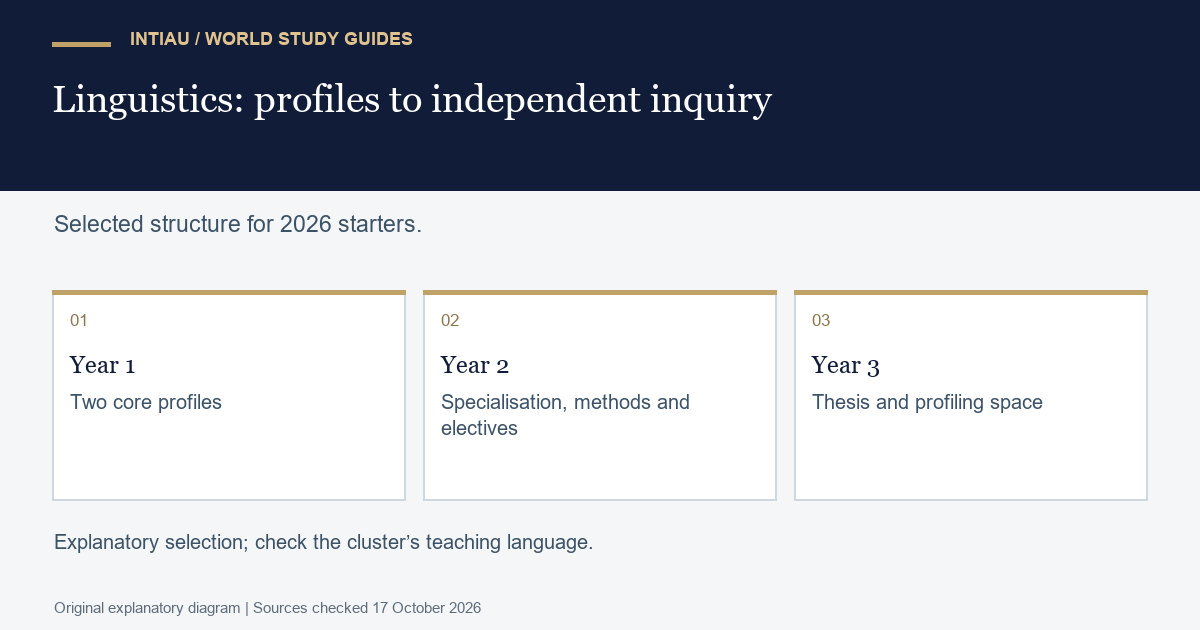
| Year 1 | Two core profiles, 30 EC each | Which theories and methods create a common foundation? |
| Year 2 | Specialisation, methodology and electives | How does the method match the question? |
| Year 3 | BA thesis and profiling space | How is an independent topic prepared and bounded? |
The prospective programme page names From Language to Linguistics, which examines language structure as part of human cognition, using English and Dutch among its examples. It also describes Meaning in language through words, sentences, reference and context.
First-year instruction is in English. Later clusters include English-taught Language and Cognition and Language and Computation, while Taal en samenleving is identified as Dutch-taught.
The language distinction matters more than the language of this guide. Do not assume every optional route is English-medium. The programme’s linked OSIRIS entries did not expose readable module detail in this research, so no assessment weights are invented. Confirm the exact cluster, unit edition and teaching language before constructing an individual study plan.
Match the application to your qualification
For a non-Dutch secondary qualification, International Student Admissions assesses equivalence to Dutch VWO. The programme requires the EMI-ready English level. Its route starts with Studielink and continues through the university application process; the page distinguishes non-EU and EU deadlines.
Checked on 17 October 2026, the page states annual dates rather than a fully dated 2027 curriculum. It gives 1 April for the stated non-EU route and 1 May for EU applicants, and says registration for the next academic year opens on 1 October. Confirm the applicable cycle and your document requirements instead of assuming that the 2026 course structure settles admission for a later intake.
Worked exercise: identify two readings before choosing one
Consider the original fictional sentence, “The student saw the researcher with the telescope.” It can describe a student using a telescope to see a researcher, or a researcher who had a telescope. Write a short context that supports each interpretation without changing the sentence.
Context A: the student was observing a distant field through an instrument. Context B: several researchers entered the room carrying different objects. The sentence is compatible with either context because the phrase “with the telescope” can attach to different parts of the description. Neither context proves what an absent speaker intended.
A complete answer should state both readings, provide the two contexts and explain what information would resolve the ambiguity. For instance, a follow-up could ask who was using or carrying the telescope. Score one point for each reading, one for context-sensitive explanation and one for avoiding an unsupported claim of a uniquely correct interpretation.
This exercise is not a Utrecht test. It helps you decide whether you enjoy investigating structure and meaning carefully. When comparing programmes, look for how introductory analysis leads to explicit methods and eventually a research question, rather than choosing only the most familiar-sounding topic.
Questions about the route
Are all later specialisations in English?
No. The published page identifies both English-taught clusters and a Dutch-taught cluster.
Does the major fill all 180 EC?
No. The 2026-starter curriculum distinguishes a 120 EC major from 60 EC of electives.
Does ambiguity mean the sentence has no meaning?
No. It supports more than one interpretation. Context can favour one without changing the original wording.
Official reading and related study
- 2026-starter curriculum
- Named course scopes and language clusters
- Qualification and application routes
Compare close textual study in the Sheffield literature guide, and record curricular choices with the curriculum-reading workshop. Browse the course and syllabus archive.
Related guides
View the study diagram