Maastricht University’s European Public Health bachelor is a separate institution’s programme, not an INTIAU programme or partnership. It is taught in English, full time, in Maastricht.
The university’s published brochure identifies the award as Bachelor of Science and the duration as three years.
This guide helps you decide whether you want to study population health through institutions, evidence and policy. Its worked comparison uses invented figures, so you can try the reasoning without collecting anyone’s health information.
Read the curriculum at two levels
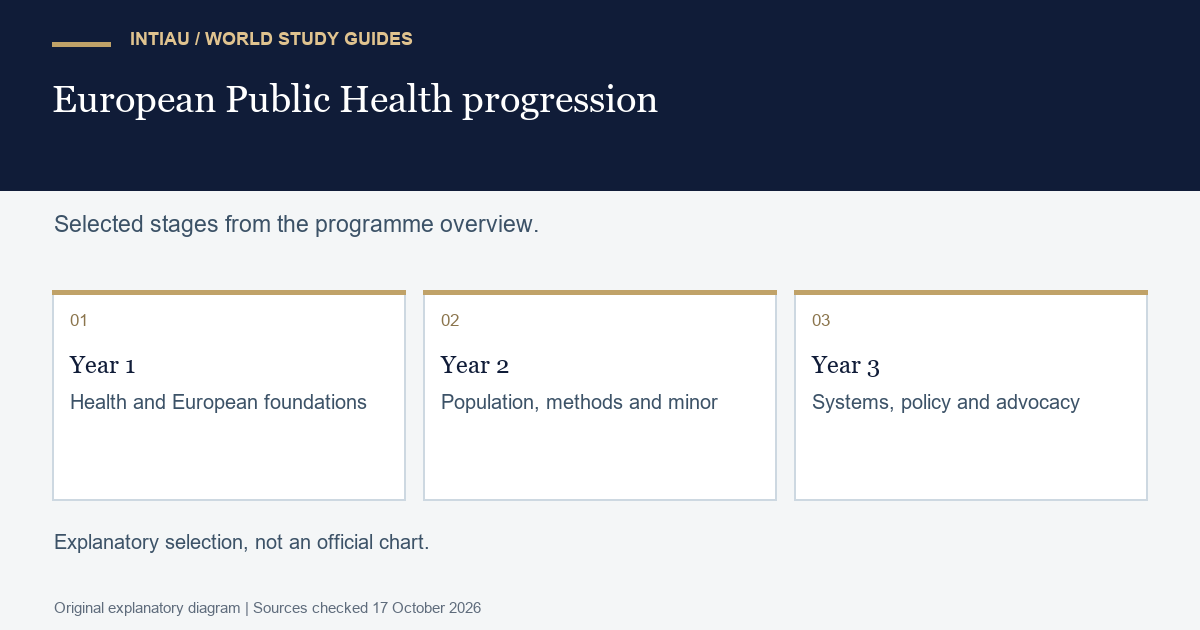
The current programme overview moves from health determinants and European institutions to demographic and lifestyle questions, then health systems and policy. The second year includes a minor period; the third includes advocacy and practical experience.
| Stage | Published focus | Question to take into your reading |
|---|---|---|
| Year 1 | Health, disease, sustainability and technological innovation | Which explanation connects a population outcome to its setting? |
| Year 2 | Demography, lifestyle, research methods and a minor | What would make a comparison between populations fair? |
| Year 3 | European health systems, policy and advocacy | Who can act on the evidence, and at what level? |
For a concrete syllabus example, the university’s 2025–2026 course document describes EPH1021, Health, Health Determinants and the European Union. It considers definitions of health, inequalities and EU institutions. Listed assessment includes a written examination, participation, attendance and an assignment.
That document is an earlier course edition, not a confirmed 2027 syllabus. The current online course repository did not expose its course descriptions in the accessible text view used for this guide.
Use this distinction when comparing degrees: the overview explains the intellectual direction, while a dated course entry tells you what evidence of learning was required in that edition. Do not assume that an examination format, timetable or placement arrangement will remain unchanged for your cohort.
Choose the correct application cycle
Checked on 17 October 2026, the admissions page explicitly covers 2027–2028 entry. It lists 1 April 2027 for non-EU/EEA applicants and 1 May 2027 for EU/EEA or Swiss applicants, including the relevant admission tasks. Applicants with a non-Dutch diploma need a qualification assessed against Dutch VWO level; unlisted diplomas receive individual assessment. English requirements also apply.
Make a personal checklist with three columns: the condition, the document that proves it, and the institution’s confirmation. Keep admission tasks separate from later enrolment tasks. A completed form is not itself an admission decision, and a general programme guide cannot determine how your particular diploma will be assessed.
Worked exercise: compare rates before proposing action
The following is an original, fictional exercise, not Maastricht teaching material or a medical recommendation. District A records 120 missed appointments among 1,000 booked visits. District B records 90 among 600. A newspaper draft says that A has the greater attendance problem because 120 exceeds 90. Test that conclusion.
A’s missed-appointment proportion is 120 ÷ 1,000 = 12%. B’s is 90 ÷ 600 = 15%. The absolute number is higher in A, but the proportion is higher in B. Neither measure is automatically the correct policy priority. A service planning staffing may care about total unused slots; a comparison of attendance patterns needs a denominator and comparable definitions.
A defensible short answer is: “A recorded more missed appointments, while B recorded a higher missed-appointment proportion in these fictional records.” Before suggesting an explanation, ask whether the periods, cancellation rules and populations match. Transport, booking systems and appointment types are possible questions to investigate, not established causes in this dataset.
Now write a two-sentence briefing. Sentence one should state both results without ranking the districts overall. Sentence two should request one missing piece of evidence. Award yourself one point each for correct arithmetic, explicit denominators, bounded language and a relevant follow-up question. An answer that blames patients loses the bounded-language point because the figures contain no evidence about motivation.
Questions before you commit
Is this clinical training?
The overview centres on public health, systems and policy. This guide does not establish clinical eligibility.
Is the named module a guaranteed future syllabus?
No. The detailed example is explicitly from 2025–2026. Confirm the applicable course entry and assessment for your intake.
What does the fictional comparison demonstrate?
Counts and proportions answer different questions. Reporting both, and identifying missing context, is stronger than calling one district worse from a single total.
Official reading and related study
- Programme overview
- Curriculum stages and current repository link
- 2027–2028 admissions
- 2025–2026 course descriptions
- Award brochure
For related reading, compare the McGill nursing guide when separating population and clinical study, and use the curriculum-reading workshop to record evidence. Browse further course and syllabus guides.
Related guides
View the study diagram