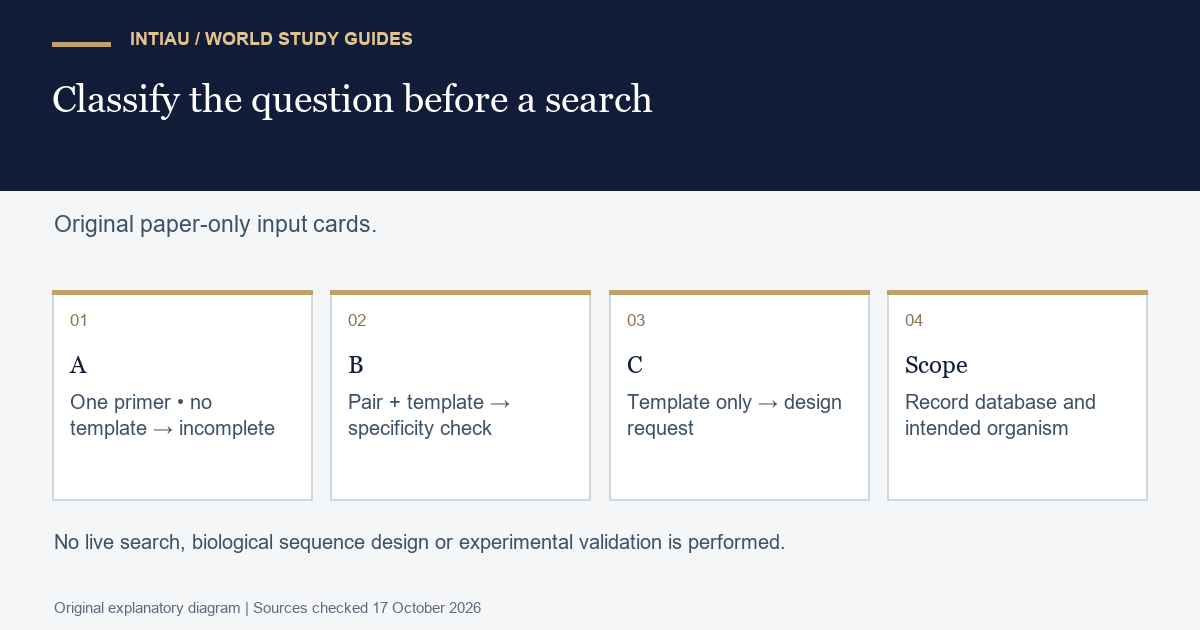
Before interpreting a software result, identify the question the supplied inputs actually ask. This workshop uses three fictional Primer-BLAST configuration cards to distinguish designing a pair from checking an existing pair. It is a paper exercise in input interpretation. No sequences, patient records or live searches are supplied, and no laboratory procedure is proposed.
Understand the input distinction
NCBI’s how-to distinguishes template-based design from specificity checking with a template and both primers. A single primer needs a template. Organism and database selection affect the scope of the check.
Bring a basic understanding of the words template, primer pair and reference database. You do not need to design a biological sequence. The purpose is to state what is known, what is missing and what a configuration can support before a result is requested.
Inspect three original configuration cards
| Card | Template supplied? | Primer inputs | Intended question |
|---|---|---|---|
| A | No | One primer | Check an incomplete proposal |
| B | Yes | Both members of an existing pair | Check that pair against a stated search scope |
| C | Yes | No existing pair | Request candidate pair design |
For each card, write a classification and one unanswered question. Keep the intended question separate from the input configuration. A person’s intention to perform a check does not mean the supplied inputs are sufficient or that the tool is being asked the intended kind of question.
Work the classifications
Card A is incomplete for the stated single-primer configuration because it lacks the template. The useful answer is a missing-input note, not a guessed template or a fabricated second sequence. Stop at that boundary and ask what the intended target information is.
Card B supplies an existing pair and a template, so the relevant mode is specificity checking. Record the database and organism scope as part of the question. A report about a specified reference set cannot silently become a statement about every possible biological context.
Card C supplies the template without an existing pair, so it represents a design request rather than validation of a preselected pair. Calling its output “verification of our original primers” would misdescribe what was entered. The input record should preserve that distinction.
A → missing template; do not invent it
B → existing-pair specificity check; scope must be recorded
C → template-based design; no original pair was supplied
Keep search scope visible
Suppose Card B’s saved notes say only “checked”. That is insufficient for review. Add the reference database, the intended organism scope, the input roles and the date or version information actually available. If a field is unknown, mark it unknown. Do not choose a biological scope merely because it produces a simpler-looking result.
The question “what was searched?” is different from “what happens in an experiment?” This paper exercise cannot establish experimental performance. A computational result, if later obtained, would need to be interpreted within its inputs and reference coverage rather than promoted to a clinical or laboratory guarantee.
Prepare a reviewable configuration note
Write three short records containing classification, supplied inputs, missing inputs and the next justified action. For A, the action is clarification. For B, it is a clearly scoped check. For C, it is a correctly labelled design request. The note should let another reader reconstruct the intended question without seeing private or unnecessary sequence material.
The question-and-method alignment workshop practises matching a method to a question. The findings and limitations exercise helps keep a result within its evidence. Further self-study is available in the workshop collection.
Questions about the configuration cards
Why not complete Card A with a guessed template?
That would change the supplied question without evidence. Identifying the missing input is the correct outcome of the review.
Why is Card C not a check of an existing pair?
No existing pair is supplied on that card. Its input configuration asks a different question.
Does a scoped computational check establish experimental performance?
No. Preserve the distinction between the reference-based question and evidence from an experiment. This workshop performs neither a live search nor a laboratory test.
Official reference
NCBI: Primer input and specificity guidance, checked 17 October 2026. The configuration cards and answers are original.
Related guides
View the worked-example diagram