The University of Manchester is independent from INTIAU; this guide examines its BSc Biology for September 2027 entry.
Biology is broad enough that a degree title alone tells you relatively little about the balance of study. A useful comparison asks how molecular explanations connect with organisms and populations, what research skills are practised, and how the student moves from following methods to judging evidence independently.
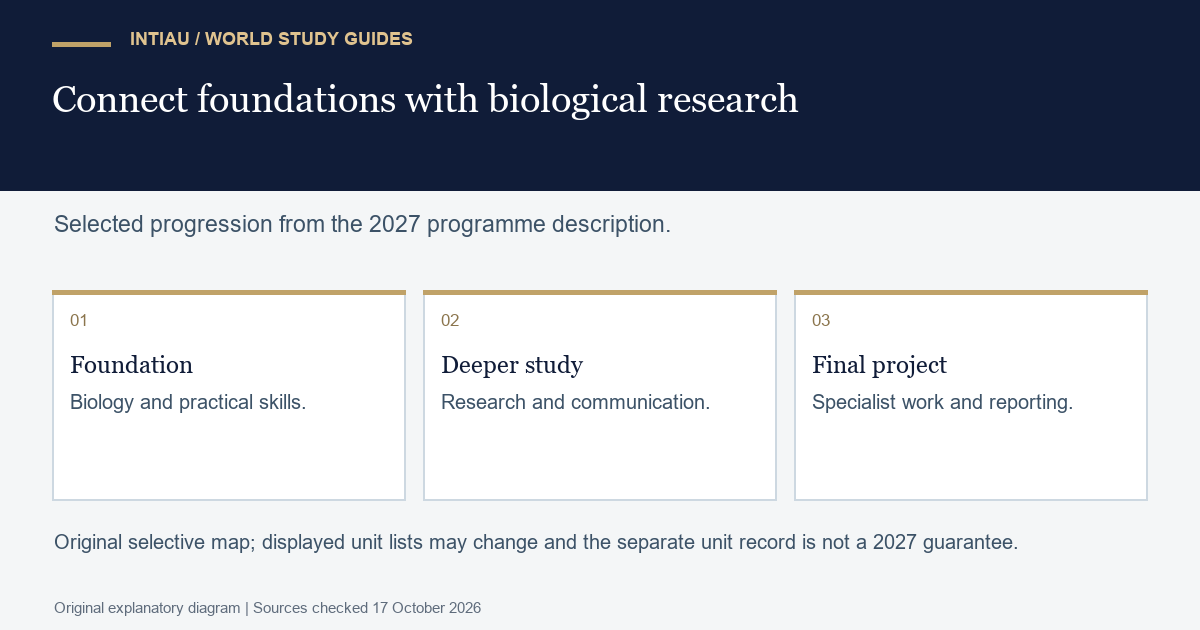
Read the progression and the status of choices
Use the 2027 programme page to check the applicable units. This selective map does not guarantee every option.
| Stage | Published emphasis |
|---|---|
| Year 1 | Broad biological foundations, data handling and laboratory skills |
| Year 2 | Deeper study, research skills and Science Communication |
| Final year | Specialist study and a project with report and presentation |
When an option looks attractive, check its status and prerequisites before building a plan around it. The distinction between a compulsory scientific foundation and an optional field course matters more than the length of an advertised list. Save the cohort year with your notes so a later revision does not silently change the basis of your comparison.
Genes, Evolution and Development in detail
The separate BIOL10521 course-unit record identifies Genes, Evolution and Development as a ten-credit, Level 1 unit taught in Semester 1. Its published content connects natural selection and population genetics with inheritance and developmental biology. Examples include genetic linkage, cell differentiation and the use of model organisms to study development.
The displayed assessment is 80% written examination and 20% coursework/eLearning. The page does not label this description as a final 2027 assessment contract. It is useful evidence of the unit’s subject scope, while the applicable cohort information still needs confirmation.
These linked themes let you ask more precise questions than whether a course “covers genetics”. Does it connect transmission between generations with variation in populations? Does it distinguish a developmental mechanism from an evolutionary explanation? Does it require interpretation of results as well as recall? Those questions make differences between similarly titled degrees easier to identify.
Original exercise: count alleles before explaining change
In a fictional sample of 100 diploid organisms, 36 have genotype AA, 48 have Aa and 16 have aa. There are 200 allele copies. A occurs 72 + 48 = 120 times, giving a frequency of 0.60; a occurs 80 times, giving 0.40. Reporting 36% as the frequency of A would confuse a genotype category with an allele.
Now imagine a second sample has an A frequency of 0.65. The difference alone does not identify natural selection as the cause. Before interpreting it, ask about sample size, sampling method, migration, measurement error and the time interval. A descriptive change and a causal explanation are different claims. Document the sampling protocol as carefully as the calculation, because a comparison is only as interpretable as the observations it combines.
A good short answer preserves the original counts, explains the denominator and names evidence needed to compare competing explanations. This is an original study exercise, not a Manchester assignment or a claim about a real population.
Keep counts and calculated frequencies in separate columns. That makes the reasoning reproducible and helps a reader detect whether a later comparison uses organisms, genotypes or allele copies as its denominator.
Apply against the right entry record
The 2027 A-level offer: AAB, including two core sciences.
Manchester’s undergraduate application guidance explains the UCAS route. Use that guidance with the qualification-specific programme requirements and current timetable rather than treating a course-unit page as admission advice.
Compare the Stanford biology guide and practise organising evidence with the curriculum-reading workshop. Other subjects appear in the Courses directory.
Three questions answered
Is every displayed unit guaranteed for the 2027 cohort?
No. Confirm the applicable curriculum before selecting units.
What connects the selected unit’s three themes?
BIOL10521 relates inheritance, evolutionary processes and development rather than presenting them as entirely separate subjects.
Does an allele-frequency difference establish its cause?
No. The fictional example describes a change but needs further evidence to distinguish possible explanations.
Related guides
View the curriculum diagram